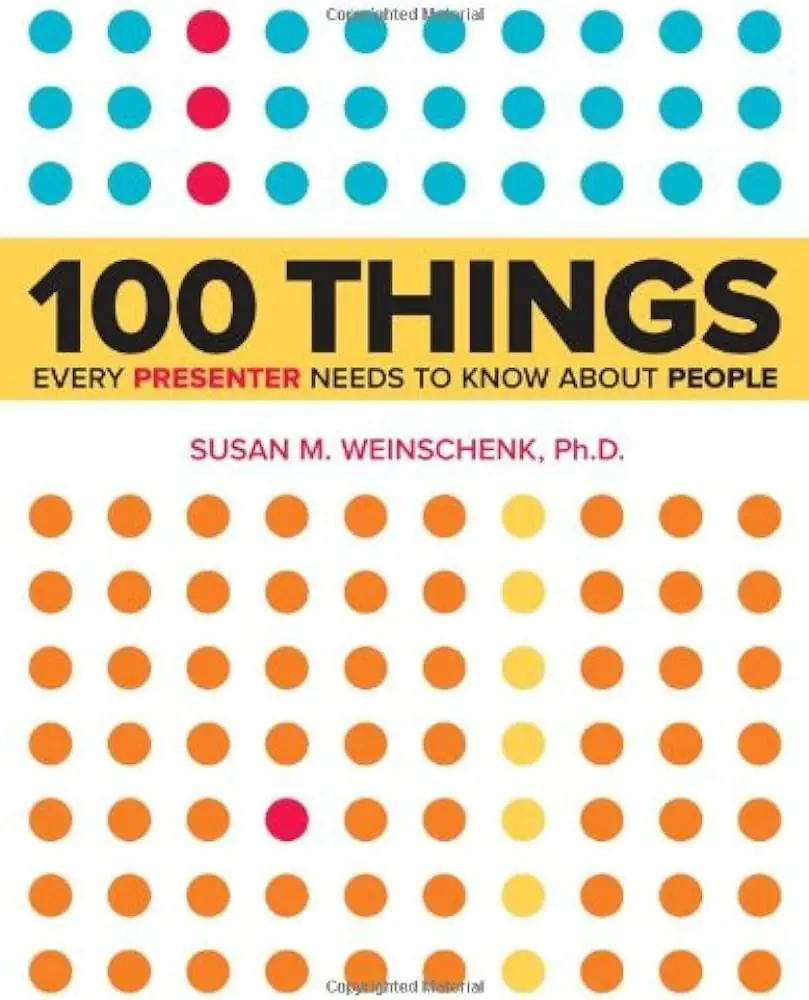
100 Principles of presentations (100 Things Every Presenter Needs to Know About People)
In any activity that I do systematically, I try to improve my skill level. To do this, I use books, articles, communication with experts. And today I decided to think about a cool book that I read before I even started speaking often. I rarely like books by type. 7 There are magical ways to succeed. 12 Steps of skill, language XYZ for 24 The hour, public speaking for 7 Days and things like that. But this book is not like this - the author really does. 100 Things that are useful to know about how people think, how they communicate, what they pay attention to, how they make decisions, and so on. This book reminded me of a mix of books about the brain and thinking that I wrote about in my book. post earlier.
If we talk about the structure of the book, it is divided into the following sections:
- How a person thinks and learns Here the author immerses himself in practical advice taking into account people’s thinking: why context is needed, why divide information into portions, how long-term memory and forgetting work, why examples are needed, how many elements a person can keep in his head at the same time, why people like to highlight categories, how culture affects thinking, and so on. This is a very interesting part, especially if you’ve studied these topics before, and now you’re just learning how it affects presentations and public speaking.
- How to keep the audience’s attention Here the author speaks about the duration of continuous attention, as well as the fact that a person is not multitasking, that the rhythm and frequency of new portions of information are important, and how attention is affected by the subconscious mind.
- How to motivate a person to work - here we are talking about dopamine, internal and external rewards, increased motivation as you approach the goal, the complexity of forming the right habits and their benefits
- How people hear and see This is about the competition of sensory channels, the importance of active listening, how important vision is and how the direction of reading affects the positioning of elements, as well as the importance of good headlines and the right font size, why we recognize faces well, and the percentage of colorblind people.
- How a person reacts to the environment - here we are talking about how the number of people in the audience changes the dynamics of the performance, about the arrangement of furniture, lighting, temperature, proximity of meals and expectations of the ability to connect to the network via WiFi:)
- Human emotional response This chapter begins with people reacting better to stories, and this response is often emotional, continuing with people loving surprises but also loving the security that comes with predictability. Next we are talking about the reaction of people to beauty, music, joy and sadness, as well as the scarcity of what we are offered.
- How People React to You This chapter is important for understanding how to behave during performances. For example, we are talking about how people react to authorities, how they react to postures and movement, sincerity and intonation, facial expressions and emotions. How important it is to get the right clothes and meet audience expectations. And why would the audience want the speaker to be in control of the situation during the performance?
- How a person decides to act This part of the book overlaps with Kahneman’s book Think Slow, Decide Fast. It’s about making subconscious decisions that fear of loss is stronger than anticipation of gain, how mood affects decision-making, about conformity and the importance of conforming to the group’s opinion. How a Leader’s Opinion Affects Collective Decision-Making and How to Use Gifts to Receive a Service
- How to prepare a presentation Here the author talks about his five-step process: research, creation, preparation of content, rehearsal. (rehearsals)speeches (lot)
- Yours. 90 daily improvement plan the author's recommendations as for 100 Days to improve your presentation skills
#Presentation #PublicSpeaking #SelfDevelopment