AI4SDLC 2026How AI is changing software development in Russia (Category AI4SDLC)
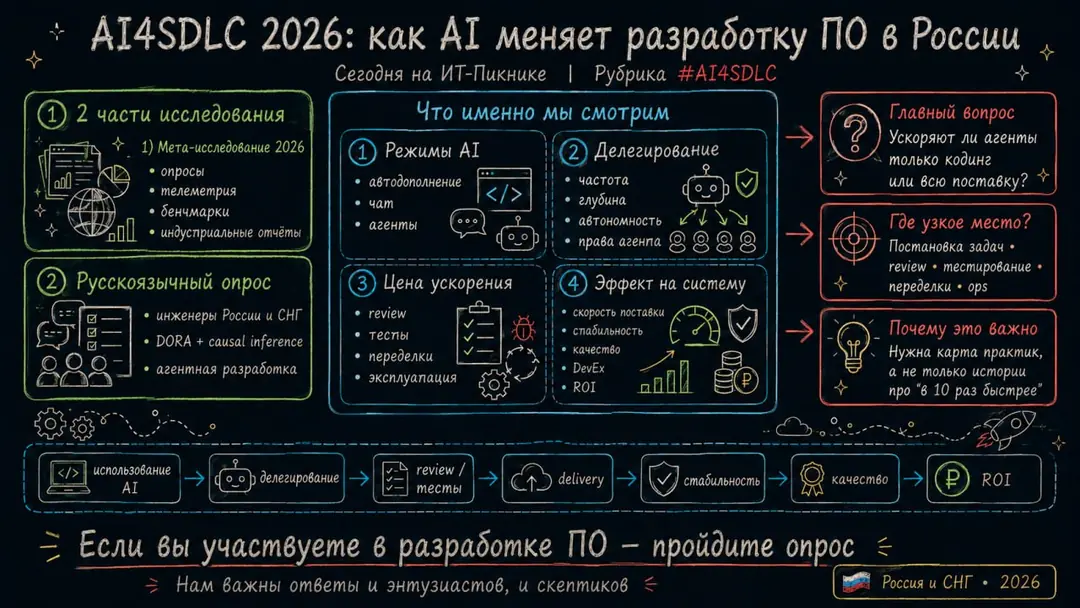
Today at IT Picnic I will talk about our AI4SDLC research. 2026 and the general state of AI in software development. We’ve already gone through a phase with assistants, and it’s exciting to see if agent-based development helps not just speed up coding, but also lead to faster and more sustainable product delivery. Or are agents simply shifting bottlenecks to task setting, review, testing, reworking, and operation?
That's what we're doing. study two-part 1Updated meta-study of publications 2026 years. We collect world surveys, telemetry, longitudinal observations, quasi-experiments, agent benchmarks and industrial reports. And we don’t put all the numbers in one basket: self-assessment, working logs and controlled experiment give different evidence. 2Own Russian-language survey engineers involved in the creation, supply or operation of software in the teams of Russia and the CIS. At the heart of this is the DORA approach with causal inferencing and standard constructs, but we re-assembled the questions under the topic of agent development that we were interested in.
We don’t mix auto-addition, chat, and background agents into one “uses AI” metric. Separately, we look at tasks, frequency, depth of delegation, autonomy, agent rights and parallel flows. We link this to supervision, cost of verification, alterations, DevEx, training and understanding of the codebase. At the team level – with the speed of delivery, stability, reliability and product quality. For managers, there is a thread about the organization’s goals, costs, and ROI.
Why do we believe that this will help us to see the state of affairs in Russia?
Not because a voluntary survey automatically becomes an industry census. We directly fix this limitation. But this design does not allow us to collect the stories “we are ten times faster” but rather a map of the practices and connections between them. Participants are recruited through multiple channels; consider the role, experience, team country, industry and size of the organization. We compare managers and specialists, users of different AI modes and those who almost do not use it. Hypotheses, cleaning rules, and an analysis plan are recorded before the results are viewed, and the report will show segment sizes, omissions, and limitations.
For me, it is important to avoid two extremes: not to declare AI useless in one failed experiment, and not to mistake the sense of acceleration for the efficiency of the entire engineering system.
If you are involved in software development - survey. It’s not just AI enthusiasts that we need answers: the experience of skeptics, rare users, and teams who haven’t moved on to agent development is just as important. I would be grateful if you send a link to colleagues - engineers, architects, team leaders and development managers.
#AI4SDLC #AI #Engineering #Research #Management #Metrics