Anthropic: Three Scenarios for the Economy with AI Through 2030 (Series #AI)
Forecasts of AI's economic impact differ by an order of magnitude: from "one extra percent of GDP" to "GDP doubles in five years." They are hard to argue about because everyone uses a different model. In September 2026, economists at the Anthropic Institute (Anton Korinek, Charles Jones, and co-authors) released the 50-plus-page paper "Economic Scenarios for Transformative AI" and the interactive Economic Scenario Explorer (the part I actually managed to get through). What interests me is the idea itself: an argument about the future becomes an argument about a few numbers that can be measured. The model takes its mid-2026 starting point from data on Claude usage, including the "Anthropic Economic Index," which I have written about before.
1️⃣ How the model works
Here the economy is a set of tasks. AI affects only "cognitive" occupations: management, professionals, sales, and office work, which account for 62.4% of US employment. The model leaves construction, repair, care, and transportation untouched; it has no robots. A scenario is set by five dials:
- what share of tasks AI can do;
- where people actually use it;
- how many times faster it makes a task;
- whether it replaces a person or augments them;
- how long a displaced person takes to find work in another occupation.
2️⃣ Three scenarios for 2030 (relative to the path without AI)
- Modest, "like the internet": GDP +1.6%, unemployment 3.9% versus 3.8%.
- Substantial: GDP +8.3%, growth of 5.4% a year (the dot-com peak was 4.7% in 1999), the labor share of income falls from 60% to 56%, and unemployment among cognitive workers rises from 2.9% to 4.5%.
- Extreme: GDP +32%, growth of 15% a year, a labor share of 45%, cognitive workers' wages 11.5% below the no-AI path, their unemployment at 17.9%, and overall unemployment at 11.9%.
3️⃣ What I think matters most
The mechanics are the same in every scenario: output rises, cognitive employment shrinks, and other occupations gain (in the extreme scenario, their wages are 34% above the no-AI path). The scenarios disagree only about size and speed. In the model, the gains go primarily to the owners of capital: in the extreme scenario, labor income stays roughly at its no-AI level, while capital income rises by 81%. By the authors' estimate, the losers could be compensated with transfers of about 9% of GDP, but historically such transfers have not happened on their own. And one uncomfortable detail: the scenarios diverge mostly after 2027, so today's data cannot tell us which one we are living in.
The authors state plainly that this is not a forecast and that the scenarios carry no probabilities. The simplifications are serious: the US only, no robots, no financial shocks or policy response, and a displaced worker immediately earns the wage of the new occupation with no loss for tenure.
4️⃣ Try it on yourself
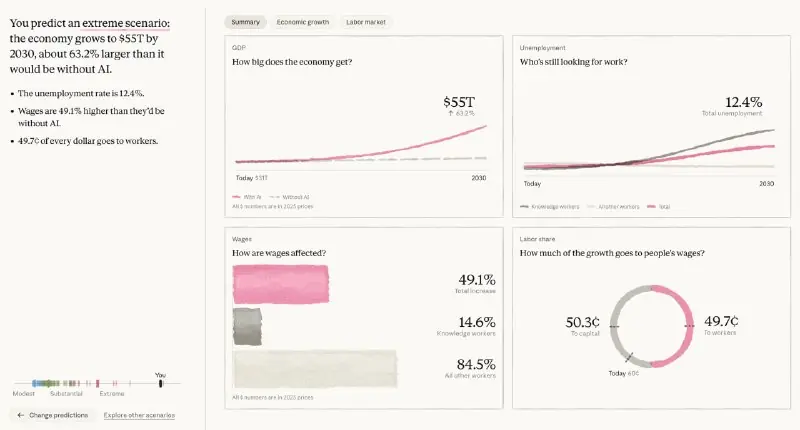
In the Explorer, you can answer five questions and get your own 2030. For comparison, in August 2026 the authors surveyed 10,980 Americans, and the median response produced roughly the substantial scenario. Incidentally, my own prediction turned out even more extreme than the authors' most extreme option (the image attached to the post shows my prediction).
But beyond simply getting a prediction, it is more useful to apply the framework to your own profession. List the tasks of a typical week with their share of your time, and for each one answer:
- can AI do it now, by 2027, by 2030;
- do you already use it there;
- does it work instead of you or alongside you;
- what new tasks AI has created for you.
The "instead of you" share is your personal level of AI autonomy; new tasks are what the model calls reinstatement. Separately, estimate honestly how many months a move into an adjacent role would take. A hint from the paper: among unemployed managers and professionals who find a job, only 10% end up outside cognitive occupations, compared with 28% in sales and office work.
Run your own version and tell us in the comments which scenario you got for your profession and which dial moved it the most.
#AI #Research #Management #Metrics