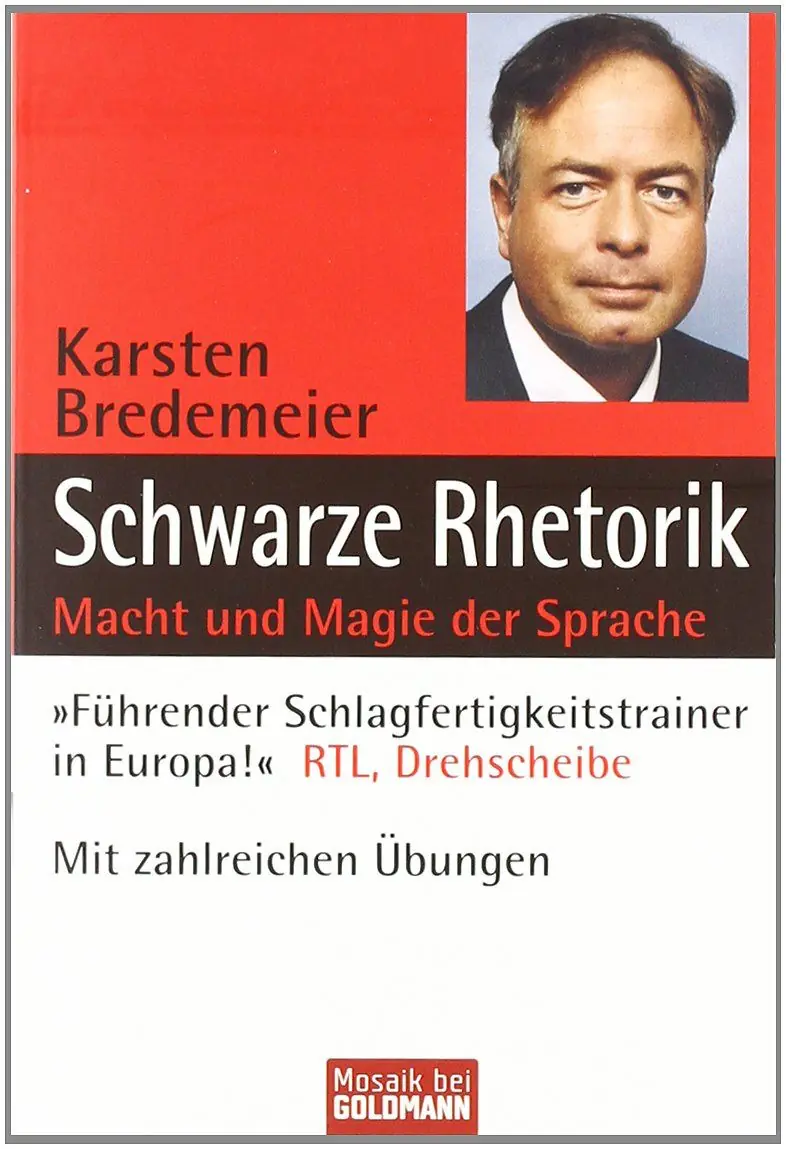
"Black rhetoric." Power and magic of the word" ("Schwarze Rhetorik - Macht und Magie der Sprache")
A short book by Karsten Bredmeier. It is short, clear, simple and useful:) There are many examples for independent work that allow you to test the approaches proposed by the author.
In the book 5 parts: definition and limits of use
- basic rules
- tricks
- asking questions correctly
- use of appeals
In the first part, the author defines black rhetoric as “the manipulation of all necessary rhetorical, dialectical, eristic and rabulistic techniques in order to direct the conversation in the desired direction and bring the opponent or the public to the conclusion and result desired for us.” Next, the author examines this definition in detail and its meaning. In the basic rules, the author says Use of anonymized "me-he" messages
- ways of formulating the main idea Cascading technique to interrupt non-constructive questions How to respond to questions and what to answer a question is to agree with the correctness of its formulation
In tricks, the author highlights 11 points:
- "Fake-ups", remarks and maneuvers are needed to demonstrate their superiority.
- First of all, you should learn to make the interlocutor listen to you.
- During discussions, it is not the essence that helps to achieve your goal, but how you present it.
- Overcome your fears, including communication fears
- bluff if circumstances require it.
- Silence is sometimes better than words.
- Change the paradigm if necessary, changing roles in communication
- carefully check the information provided and do not allow the focus to shift to secondary
- Your position is alpha and omega, start and end with it.
- Don't fall for argumentative tricks
- demagoguery
By the way, an interesting list of tricks 10 paragraph:
- black and white argumentation Violation of logical or temporal sequence in the chain of argumentation
- analogy as pseudo-proof
- the argument of inevitability Negative spiral argument The argument of alleged accuracy of the proof
- a trick of authority of opinions and Anglicisms
- evidence trick
- a ploy of personal authority
Interesting analysis by the author of the question. He notes that There are a lot of stupid questions that cause us to lose initiative and lose our karma. There are a lot of smart questions. Some people do not care about the essence of the conversation, but it is important to dominate it. There are many superficial questions. Next, the author highlights open, semi-open and closed questions. And then it gives a taxonomy of the kinds of questions, breaking their use into positive and negative. I like this list, but it is better to read it in the original. Well, the book ends with the use of appeals, which can be a good enough tool ... if you do not overdo it. P.S. Read books – it will improve your knowledge! Use this knowledge and improve your skills! 🙂
#PublicSpeaking #SelfDevelopment #Storytelling