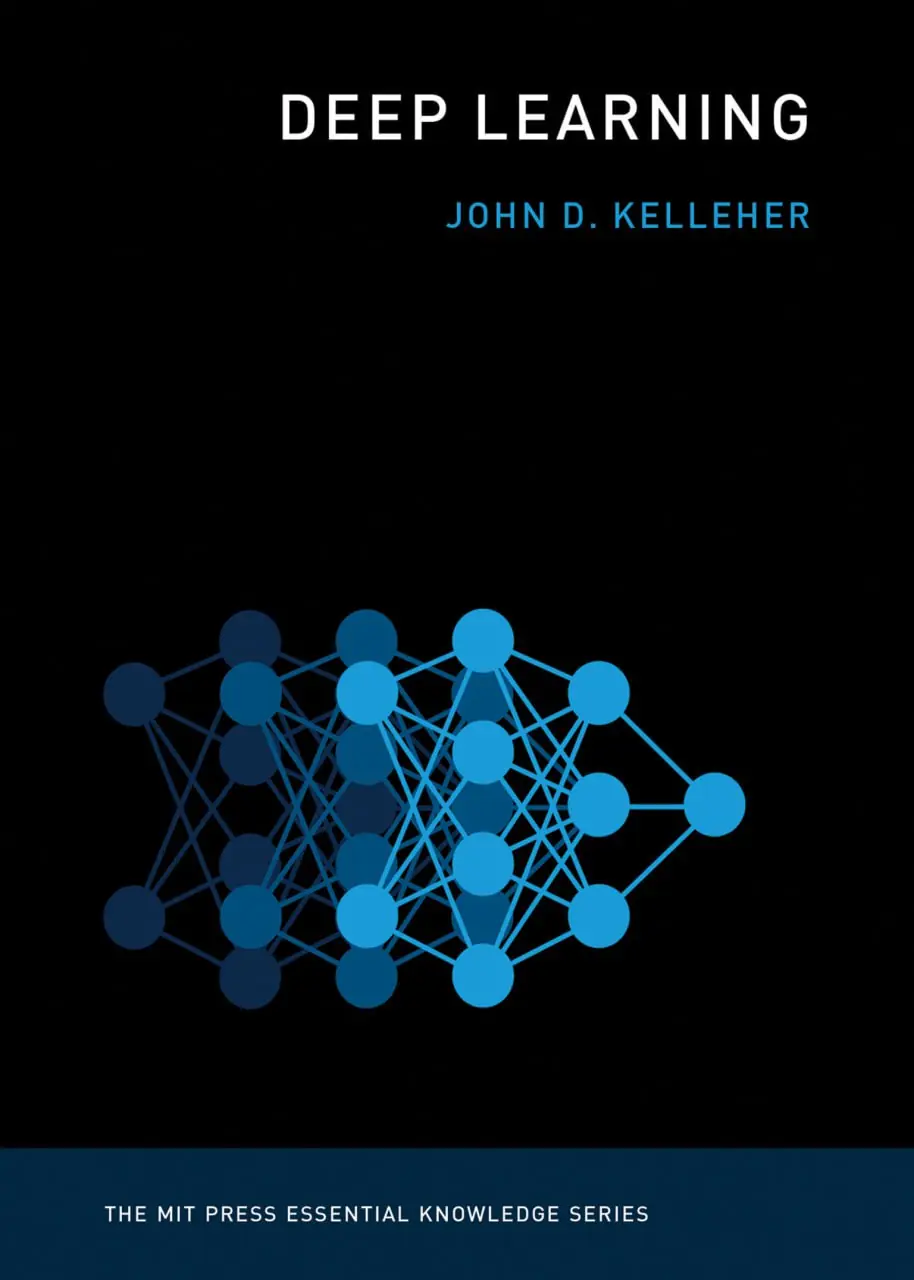
Deep Learning by MIT Press
This book John D. Kelleher The Essential Knowledge Series is an interesting introduction to deep learning. I already am. told The other book, "Data Science," from the same series, in which he co-authored. In this book, the author talks about neural networks on the fingers and only in one chapter. (about backpropagation) He's getting a little bit into math. At least from the publication of the book in 2019 A lot of water has leaked this year, but it still seems like a good overview of deep learning for people far from ml. The book itself consists of 7 heads 1. Introduction to deep learning The introduction begins with the fact that deep learning helps to make decisions based on data. The author recalls the three terms AI (artificial intelligence), ML (machine learning)Deep learning, and shows their nesting in each other: deep learning , ML , AI. The following is an example with a simple dataset, a function as a deterministic mapping of input values at the weekend, and then the transition from determinism to guessing a function using inputs and outputs available in the dataset. (finger-explanation). Of course, you can not always guess exactly and much depends on the available dataset. Further on the fingers understand learning with the teacher, without him, as well as reinforcement learning. And by the end of the chapter, the author talks about the reasons for the success of deep learning: that we do not have to deal with the allocation of significant features ourselves. (feature engineering)It also works well in a domain with a lot of features. (dimensionality) and a lot of data (I would like to add the importance of a large number of GPUs.). By the way, this text mentions AlphaGo, which is cool. documentary. 2. Conceptual foundations - here we talk about what a model is, how you can choose the parameters of the model using available data, how combining simple models you can get an integrated model 3. Neural networks: the building blocks of deep learning Brief explanation of neural networks, how they work and where the name deep neural networks came from (Hidden layers between input and output layers) 4. A Brief history of deep learning Here the author gives an extract from the history of the development of neural networks, and the focus here is on both conceptual and practical breakthroughs. This description of history seemed to me less biased than in the book.Anthology of machine learning” ("The Deep Learning Revolution"), about earlier. Separately, the author explains why deep learning has become so developed in recent years - there is a cycle of three elements that reinforce each other: big data, improving algorithms, improving iron. 5. Convolutional and recurrent neural networks - here describes the work of convolutional and recurrent neural networks, where the former are great for working with images, and the latter is better for working with text. And the description of neural networks is given literally on the fingers. (I think that people will understand it, that they are far from mathematics.) 6. Learning functions This chapter is the most mathematical of all and here we are talking about gradient descent and backpropagation algorithm. The first algorithm is absolutely standard for the task of finding the minimum / maximum function, but the error backpropagation algorithm in the 80s greatly advanced deep neural networks in popularity, since this method allowed to determine how to change the weights of hidden layers in a neural network during training. In fact, it is when considering backpropagation that you need to know a little about partial derivatives. 7. The future of deep learning The author describes the bright future of deep learning. 4 In the last few years, it seems that LLM has come. (large language models)
In general, the book is quite easy to read and great for an initial acquaintance with this field at the level of scientific literature:)
#ML #Data #Learning #DataScience #Software #PopularScience