DeepSeek in action (DeepSeek in Action) (Books column)
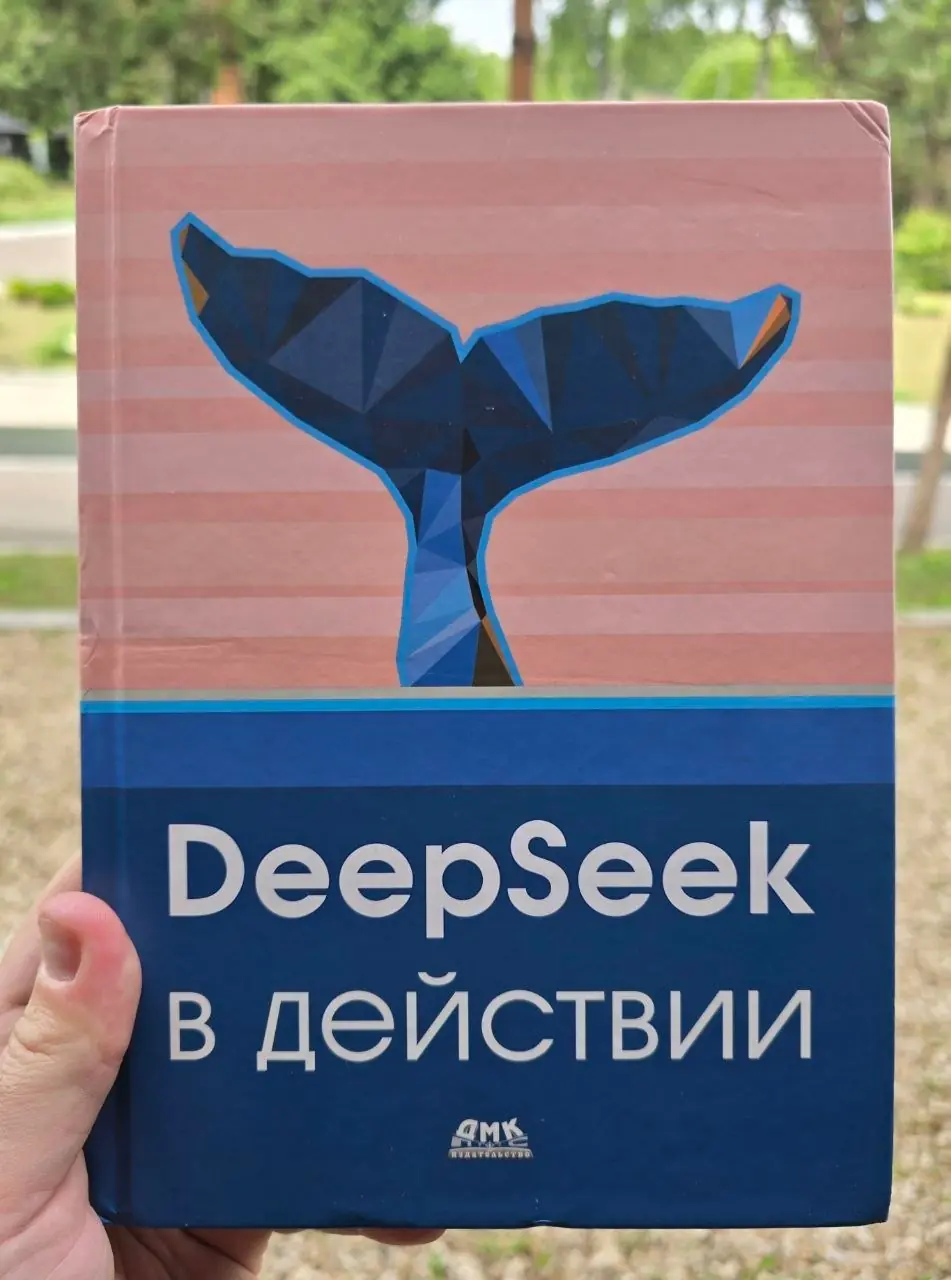
I finally finished reading DeepSeek in Action, which was funny. 1 July 2025 Yatsenkov was the translator of the year at DMK Press, and the original is called “DeepSeek in Action: LLM Deployment, Fine-Tuning, and Real-World Projects” from the Chinese “Laboratory of Artificial Intelligence of the Future”. I read the first part almost immediately - literally a couple of days after receiving, and then it hung in a pile for a long time. The fact is that it consists of two blocks of unequal quality.
1Why DeepSeek has become an engineering event The first one deals with the basic architecture of Transformer and those improvements to DeepSeek that stirred up the industry a year and a half ago: MoE, attention mechanism, memory and computing optimization, variable-bit learning, distributed optimization. That’s exactly what the book was worth opening for. 2How to use the DeepSeek API Here, the authors talk about how to generate texts, solve mathematical problems, write code, collect chat clients. I understand why such chapters are needed by the mass reader, but read them in the 2026 The year is boring. Around the LLM API, everything quickly becomes commodity: endpoint, key, request, answer, a little caching, another demo.
But the first part deserves a brief mention, since it is there that the authors talk about engineering tricks, which now look like a standard.
1️⃣ MoE (mixture of experts) flat (dense) model A model can have a lot of parameters, but for a specific token only a fraction of the experts are activated. In DeepSeek-V3, according to the technical report, there are only 671B parameters, but 37B are activated. The scale is growing, and the calculation remains sparse. 2️⃣ Multi-head Latent Attention, MLA An ordinary Transformer in a long context rests on KV-cache: you need to store the keys and values of past tokens, and this quickly becomes expensive in memory. MLA compresses Key-Value cache into latent vector. This gives a strong reduction in KV-cache and growth throughput. 3️⃣ Auxiliary-loss-free load balancing The authors are moving away from the auxiliary loss for balancing experts, so as not to spoil the quality of the main task. 4️⃣ Multi-token prediction This is when the model on training predicts not only the next token, but several next ones. It is an attempt to squeeze more quality and speed out of the training objective itself. 5ные Engineering moments The authors used FP8/mixed precision, distributed learning, parallelism, and communication between GPUs. According to the report of DeepSeek-V3, the model was pre-trained 148T tokens, and full training cost 2.788M H800 GPU hours. These figures are worth reading as an assertion from the authors’ technical report, but they explain why DeepSeek sounded so loud: the industry saw not just the quality of the model, but a bid for a different learning economy.
In the first part of the book, the remaining 250 Pages about using APIs look just like a text placeholder, which is not clear why read:) Especially now. And it shows that AI books are not only becoming obsolete quickly, but also unevenly. Even now, the architectural part of this book looks useful and the rest is gone.
P.S. I forgot to mention that now the guys from DMK Press translate a lot of Chinese technical books directly - I have a whole pack now in the todo sheet, and I took a couple with me on vacation, so maybe I will write about recommendation systems based on LLM:)
#Books #AI #DeepSeek #LLM #Engineering #Software #SystemDesign