The Man from the Future: The Visionary Life of John von Neumann (#Books)

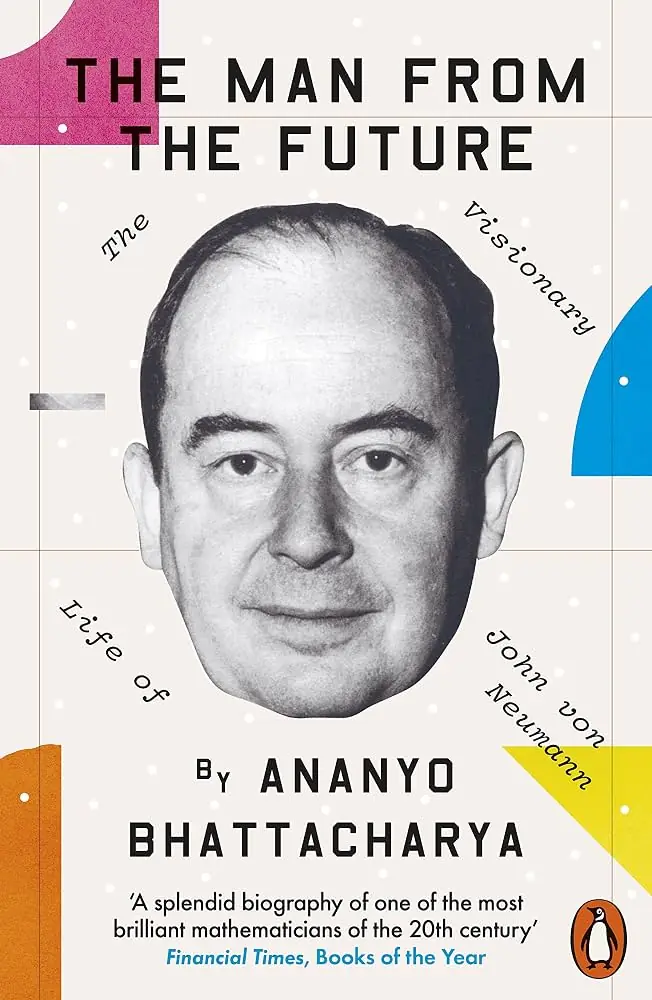
I already mentioned Ananyo Bhattacharya’s “The Man from the Future” when I started reading it. Now I have finished it, and I really enjoyed it. What impresses me most is how much its subject, John von Neumann, managed to do across completely different fields.
In computer science, his name is familiar through the von Neumann architecture: programs and data are stored in the computer’s memory. He was a key participant in the emergence of computing. That alone would have been enough for a substantial scientific biography.
But then come the mathematical foundations of quantum mechanics, the proof of the minimax theorem, and “Theory of Games and Economic Behavior,” written with Oskar Morgenstern in 1944 and foundational to game theory. Then there is his work on the Manhattan Project: calculations of explosive compression of a nuclear charge and the behavior of shock waves. Mathematics was quite literally changing the world, and far from exclusively for peaceful purposes.
Von Neumann was also one of the founders of cellular automata and developed a theory of self-reproducing machines. It was a mathematical model: cells change state according to defined rules, and a structure built from them can reproduce itself. Someone working on early computers was already asking how a machine might make its own copy. Meanwhile, he investigated what computing machines and the human brain have in common. You may know cellular automata through John Conway’s Game of Life and Stephen Wolfram’s elementary cellular automata.
A beautiful mind capable of a great deal. I recommend this book to anyone interested in the history of science and people whose ideas could span several disciplines.
Still, the story has a sad ending. Von Neumann died of cancer on February 8, 1957, at 53. He saw early results of his work, but did not live to see computers become an everyday presence. A man who did so much for the future spent surprisingly little time in it himself.
P.S. I have previously mentioned von Neumann’s “The Computer and the Brain”, published posthumously and originally intended as the Silliman Lectures at Yale. It is written simply and clearly, and shows how far ahead of his time John was as a visionary.
#Books #History #Math #Engineering #Architecture #AI