Find the Idea. Introduction to TRIZ - Theory of Solving Inventive Problems
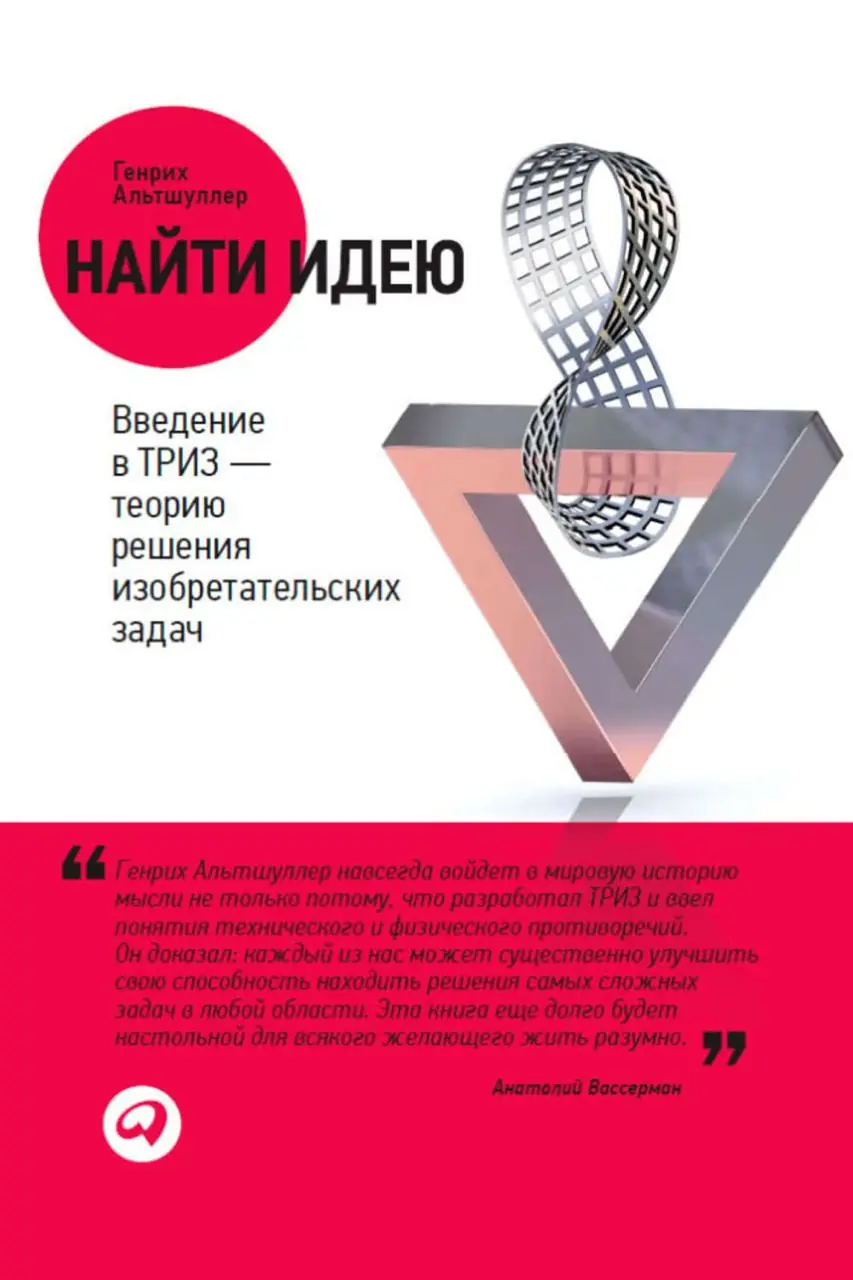
Recently in the comments to post On Gregor Hohpe’s report on architecture, a discussion has been sparked about compromises and why IT architecture often seeks them out, even though real-life compromises often lead to a less-than-better solution. There I gave the example of TRIZ as a way to solve engineering and production problems without focusing on compromise, and today I decided to recall the book from the author of the concept, Heinrich Altshuller, “Find an Idea”. Introduction to TRIZ”.
This isn’t my first book, but it seems like the best.) The author perfectly managed to talk about how complex, long and expensive the process of solving inventive problems by trial and error. Further, the author considered the options for activating the search, such as the morphological method, the method of brainstorming and synctecics, showing that they do not give a qualitative breakthrough. But it gives TRIZ according to the author. The rest of the book is devoted to teaching the basics of this method. The appendices of the book are presented 40 the main methods of eliminating technical contradictions, the algorithm for solving inventive problems85-In, etc.
The book is unambiguously interesting, and not only for the inventors of technical systems, but absolutely everyone, because it perfectly describes the algorithm of transition from a vaguely described task to a technical one. The concept of ICR (perfect end result)Intensify conflict to get a quality solution instead of a compromise. However, in order not to feel helpless in solving the problems given in the book as examples, it is good to know the basic physical and chemical effects, since often the solution is based on their use:)
P.S. The book was first published in 1986 This year and has been reprinted several times since.
#SystemDesign #SystemThinking #TRIZ #Architecture