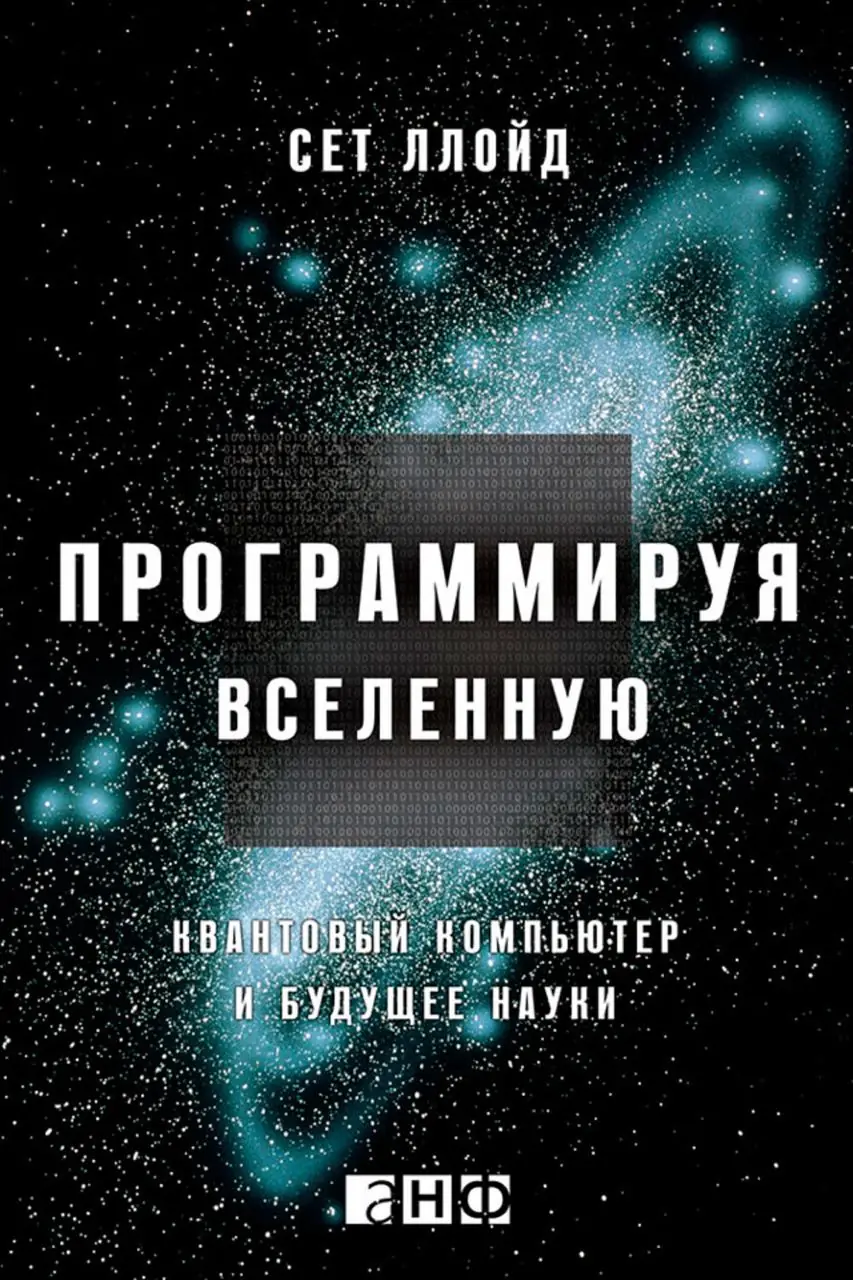
Programming the Universe: A Quantum Computer Scientist Takes on the Cosmos (Programming the universe. Quantum Computer and the Future of Science)
Today I decided to recall Seth Lloyd’s book Programming the Universe. Quantum Computer and the Future of Science. This book combines my interests in the development and reading of popular science literature:) In addition, this particular book reminds me of learning theorphysis at MIPT. 15 years ago:) Now let's get to the book itself. In it, the author sets the tone from the introduction, where he proposes to perceive the universe in terms of information processing.
- In firstThe author tells about the revolution in information processing and when and how the idea of a quantum computer appeared.
- In second The author talks about the concept of computing: information, computer, logic circuits and non-computability.
- In third The concept of a computational universe is essentially a giant computer in which every atom and every elementary particle contains bits of information, and every time two atoms or two particles collide, those bits change their values. The computational nature of the universe gives rise to its entanglement and complexity: everything that can be computed ... exists somewhere in the universe.
- In chapter four The author considers the question of information and physical systems, starting with statistical physics and beyond.
- Actually in fifth chapter Quantum mechanics is considered, starting with the double-slit experiment, continuing with Schrödinger’s cat and ending with the multi-world interpretation of decoherent histories.
- In sixth "Atoms at work" the author tells how you can make a quantum bit - a qubit using a nuclear spin and a photon.
- In seventh The author talks about the universal computer and simulation of the universe, as well as its computing power. At the end of the chapter, the author talks about the model of quantum computing and quantum gravity.
- Chapter eight I like ‘Simplifying Complexity’ very much because it is the most conceptual one in which the author considers the various concepts of complexity that he breaks down into different concepts. 4 type:
- How hard it is to describe something (For example, algorithmic information)
- How hard it is to do something (for example, computational complexity)
- degree of organization in the system
- non-quantitative ideas about complexity (such as self-organization or adaptive systems) Further, the author introduces the concept of effective complexity, which is equivalent to the information necessary to describe the regularity of the system. Funny what the author says about the KISS principle. (Keep It Simple Stupid). And then, based on the concept of effective complexity, the author explains why the universe is complex.
In general, I liked the book both from a philosophical point of view and some practical information about quantum computers, the enchanting arrival of which we have been promised for some time:)
#PopularScience #Physics #Software