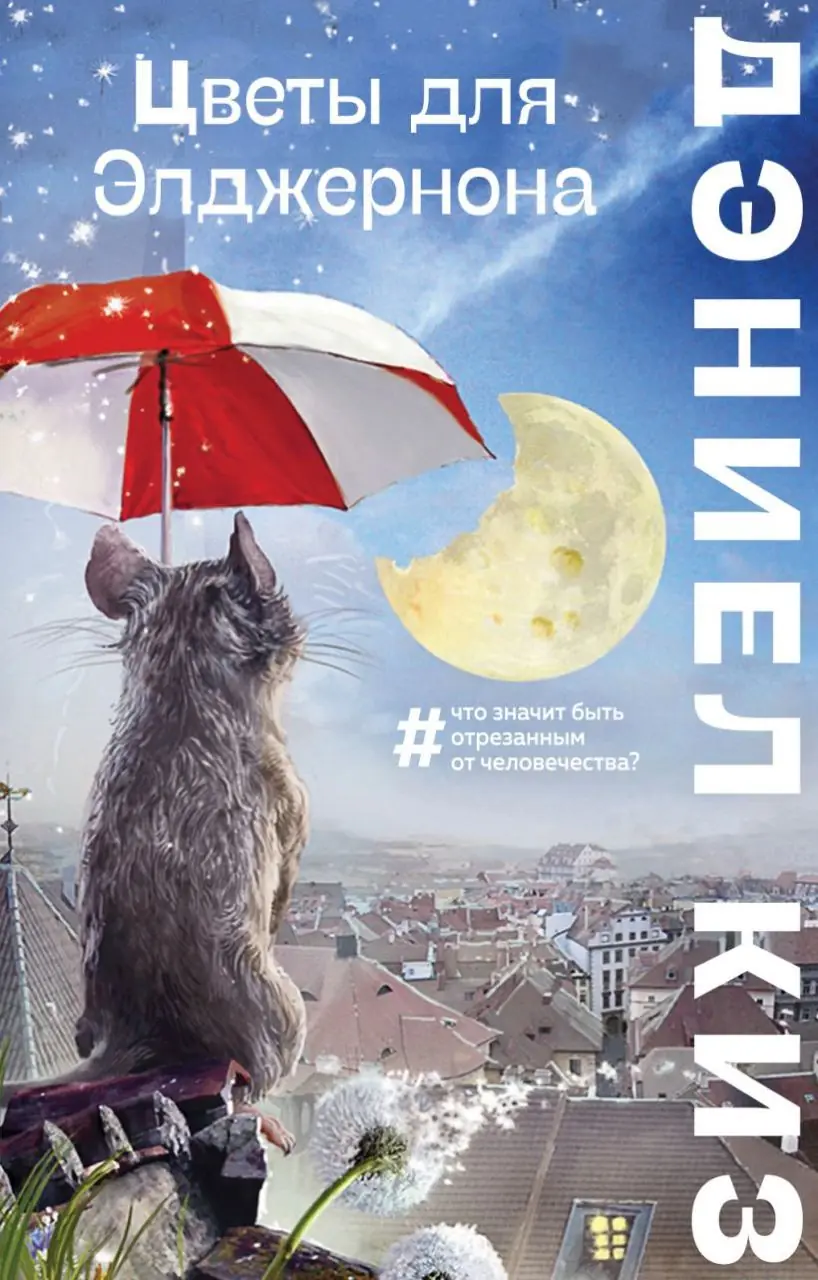
Today I decided to recall the story "Flowers for Algernon", which won the "Hugo" award for the best short science fiction story in the world. 1960. And I got it for a reason.
The format of the presentation in the form of a diary of the main character, whose name is Charlie, allows you to look at the changes in perception from his position. At the very beginning of the story, Charlie appears to us mentally retarded, responsibly doing his job and wanting to become smart. Charlie diligently learns to write and read at night school, where he is found by a pair of scientists who need a subject. Charlie agrees to an experiment that should boost his intelligence and he hopes it will make him happier. It turns out that a successful experiment brings him the expected increase in intelligence, but he still finds himself detached from society ... just now on the other tail of the Gaussian curve ... As a result, this change turns out to be temporary and, as time runs out, there is a regression ... first in Algernon, a white laborate mouse and Charlie's only real friend, and then in Charlie himself. The main character’s swan song is a study of the “Algernon-Gordon effect: an investigation of the structure and functions of artificially enhanced intelligence”, in which he justifies the regression that is inexorably waiting for him. Algernon dies in the lab, Charlie buries him in the backyard. And then, as the effects of fading intelligence manifest, he has thoughts of suicide, which are not embodied, because the experiences lose their brightness as cognitive abilities decline. As a result, the circle closes and the hero returns back to the place where he started, having a vague feeling that he "sort of did something for all the stupid people like him." And in the last paragraph of the story there is a reference that gave the name to the whole work: "P.P.S. If you have a chance, please put some flowers on Algernon's grave which is in the backyard.
#SciFi