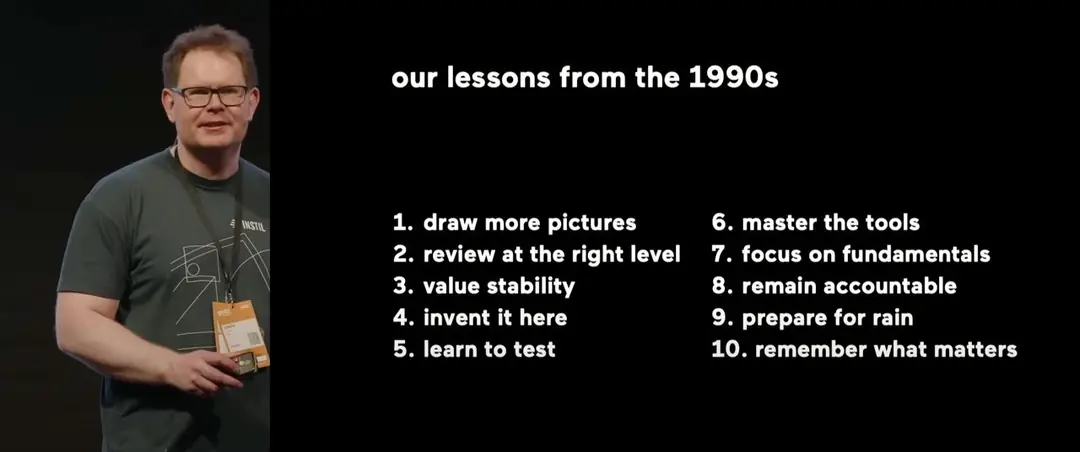
10 Programming Lessons From the Past • Garth Gilmour & Eamonn Boyle • GOTO 2022
Another one. play This time at the conference and the lessons we learned. (or) past 20 years of development of approaches to software development. Ten lessons the authors learned are as follows:
1. Draw more pictures - about drawing architectural diagrams, which was popular both in the 90s and now, for example, for drawing flow serverless applications. Here the authors recommend to look at the work of Simon Brown and C4 Modeling 2. Review at the right level Design review has been replaced by code review, which usually focuses on the code level. The authors propose to return the review at abstraction levels that are above the code level. 3. Value stability - here the authors consider how quickly technologies change and that it is not the knowledge of a new and fresh js framework that is important, but what remains with us for a long time - the ability to understand complex things and write documentation on them:) 4. Invent it here - here the authors consider the NIH syndrome of the past and the current situation, when we pull dependency not always figuring out why they are for us. Here, the authors again kicked js, citing statistics on npm packets. 5. Learn to test We used to have complex testing techniques, but now that developers are involved in testing, it usually comes down to unit tests. Respect qa engineers and other approaches to system testing 6. Master the tools The authors suggest studying the tools you use more thoroughly and using shortcuts, showing cheatsheet with them for Intellij IDEA:) 7. Focus on fundamentals People are less interested in fundamental things and more interested in shiny things like another framework.) The authors suggest going back to the roots and learning the basics. (Plus I recommend a set of books - I like to do it too.) 8. Remain accountable - here the authors say that "agile was all about professionals", but it seems to me that this is not always the case now. As a result, the authors suggest taking responsibility and responsibility for their work, focusing on principles rather than processes, understanding why everything is so arranged and ultimately being a professional. 9. Prepare for rain The authors recall the bursting of the dotcom bubble and say there was explosive growth followed by collapse and contraction. The mistake was that potential was confused with demand. (“anything can be sold online but not everything should be”). The authors suggest preparing for the downturn and thinking about your career, your training and how to stay in demand - good advice that was so soon needed. 10. Remember what matters Importance of work/life balance: Outside of work, there are important and interesting things you wouldn’t want to miss:)
#SoftwareDevelopment #Software #Management #Conference