[2/2] The AI-Native Organization: From Signal to Action (Series #Management)
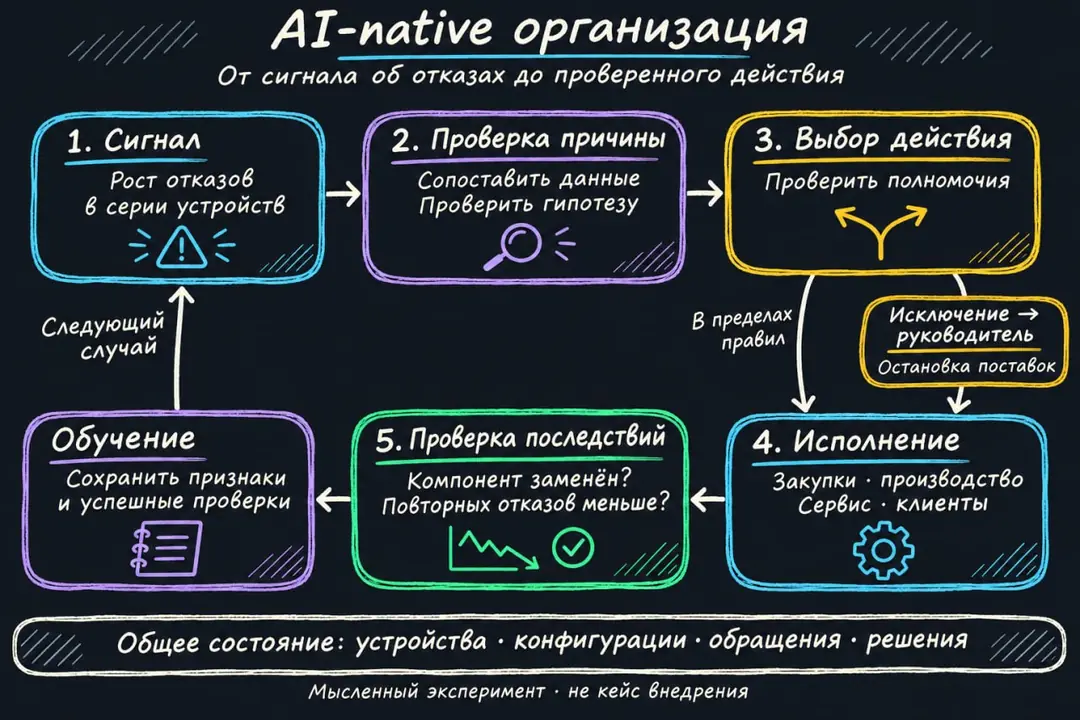
I want to pick up the idea of coordination from the previous post on Organizing Intelligence and take it to the level of a whole company. It also continues the ideas from episode eight of 3 AImigo, “AI-native: what does it mean for a company?”, where Alexey Litvinov, Evgeny Sergeev, and I discussed shared context, redesigning processes, and the queue of questions waiting for a person. Here I want to try that framework on one example from start to finish.
Imagine an industrial equipment manufacturer. Service notices an increase in failures in one product series. AI helps find a pattern, helps engineers test hypotheses, and helps support prepare responses for customers. Yet the decision to stop shipments is still waiting for a director. Execution got faster and the decision queue is still there.
For this example, I’d define an AI-native organization by its ability to redesign the whole work cycle around the AI it has available: Signal → check the cause → choose an action → execute → check the consequences.
What would it take to make that chain work under increasing load?
🔸 A connected view of the company’s state Customer requests need to be linked to serial numbers, configurations, operating conditions, and engineering changes. A hypothesis needs evidence and a status. Otherwise agents can spread the same mistake across departments very quickly.
🔸 Clear authority For example, a system can order additional diagnostics within a budget. The responsible manager considers whether to stop shipments. Each transition needs conditions, a response time, and a clear escalation path. If every action needs one person’s approval, adding agents lengthens that person’s queue.
🔸 Verifiable execution A decision to replace a component has to reach procurement, manufacturing, service procedures, and customer commitments. Closing a ticket still leaves a question: was the right part actually installed, and did repeat failures fall?
🔸 Learning from consequences Once the problem is resolved, save the signs of failure, the hypotheses you ruled out, and the checks that worked. The next case will then have tools ready to use. Those tools will need maintenance. Old diagnostics can cause errors on a new configuration.
The manager’s work changes too. I’d assess their contribution by the quality of delegation rules, decisions in disputed cases, and their ability to make a process work without their constant attention. The number of approvals handled can grow right alongside a poorly designed process.
How would you check whether this architecture helps? Increase the number of cases handled concurrently and look at time to verified action, full cost of the result, repeat failures, and manual exceptions per case. Count compute and human attention separately.
This falls short of proving that the organization has crossed the paper’s supercooperative threshold. It does give an AI-native organization a concrete test: if the flow of problems doubles, can it hold quality steady without doubling the queue for leadership?
#Management #AI #Agents #Architecture #Metrics