[1/2] Organizing Intelligence: The Economics of Coordination (Series #AI)
In the new October 29 essay “The Economics of Intelligence: How and when does AGI lead to economic transformation?” and the paper “Organizing Intelligence”, one question caught my attention: how does the economy change when intelligence can be copied? The essay is an easy read. The really interesting material is in the whitepaper, which I’ve looked through but haven’t read in full yet.
The Google DeepMind researchers consider firms that choose a mix of people and AI. Human expertise is scarce in the model, and copies of AI are rented at the cost of compute. It’s a theoretical model, so the scenarios depend on its assumptions.
People have different strengths. An organization combines them into a “mosaic intelligence,” so a team of specialists can keep an advantage over an AI that outperforms the average person. Copies of a model also reproduce its weaknesses.
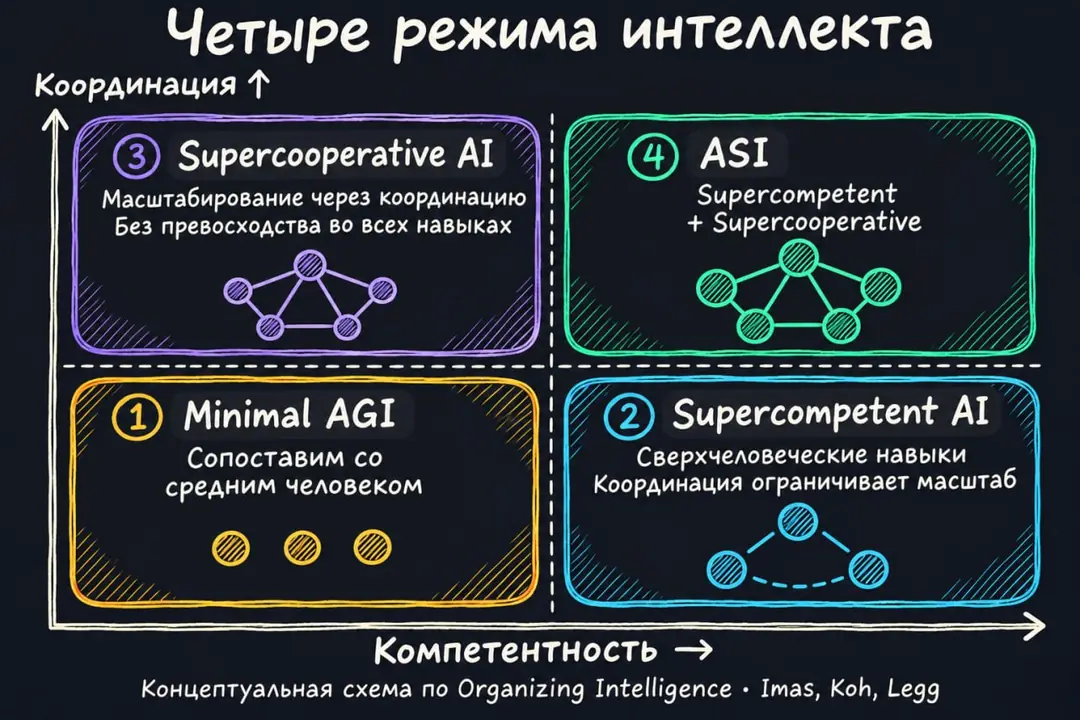
The authors distinguish two abilities: 1) Competence raises output at a given firm size. 2) Coordination determines how output scales as participants are added.
At large scales, output in the general model takes the form F(m) ≈ A × m^γ for a fixed mix of capabilities. The supercooperative threshold is γ > 1: output per participant rises with scale. In a large enough market, that can favor large AI organizations. Niche demand limits the benefit of that growth.
In the essay, the authors describe four regimes: 1) Minimal AGI — comparable to the average person. 2) Supercompetent AI — outperforms people on domain tasks while coordination still limits scale. 3) Supercooperative AI — crosses the scaling threshold without superiority in every domain skill. 4) ASI — combines both advantages (Supercompetent + Supercooperative).
Superhuman performance on individual tasks still leaves room for an economy with many small firms. Better coordination can change the structure of the market itself.
Another result from the paper is that wages change both because of the technology and because firms reorganize. The second effect can reverse the first. Individual productivity alone doesn’t determine pay.
To measure these effects, the authors propose testing how identical copies scale with fixed compute per copy, and also comparing generations of systems at the same total budget. The paper doesn’t establish a universal measured coordination coefficient for today’s systems.
I’d pay particular attention to what counts as output. If eight agents produce twice as many changes but integrating them takes three times as long, the completed-task counter will make the result look like a convincing success. I’d measure accepted output together with the cost of coordination, fixes, and human attention.
I’d like to take the question into an AI-native company: how does it make decisions and follow through when it can add people or agents to do the work much faster than it can add managers? That’s what I’ll cover in the second post.
#AI #Research #Agents #Management #Metrics