How do corporations spend money on AI?
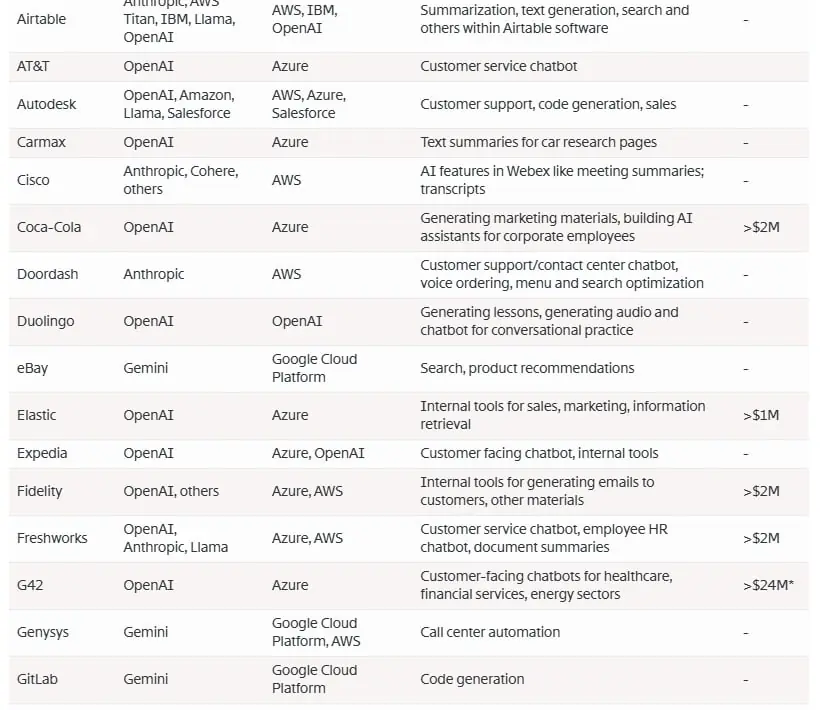
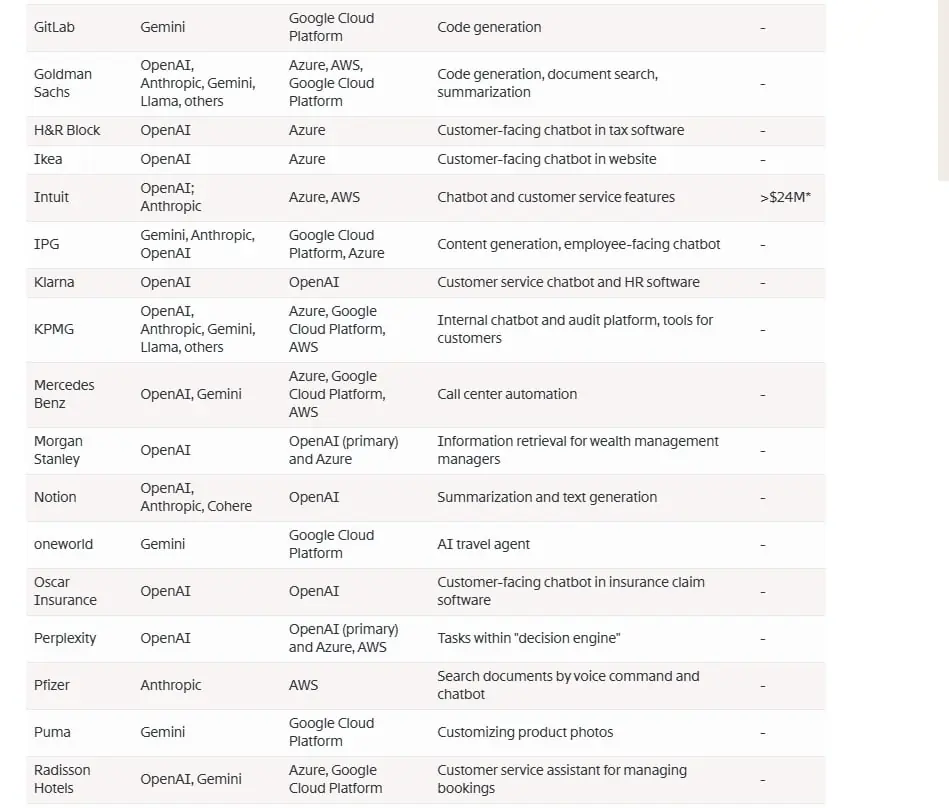
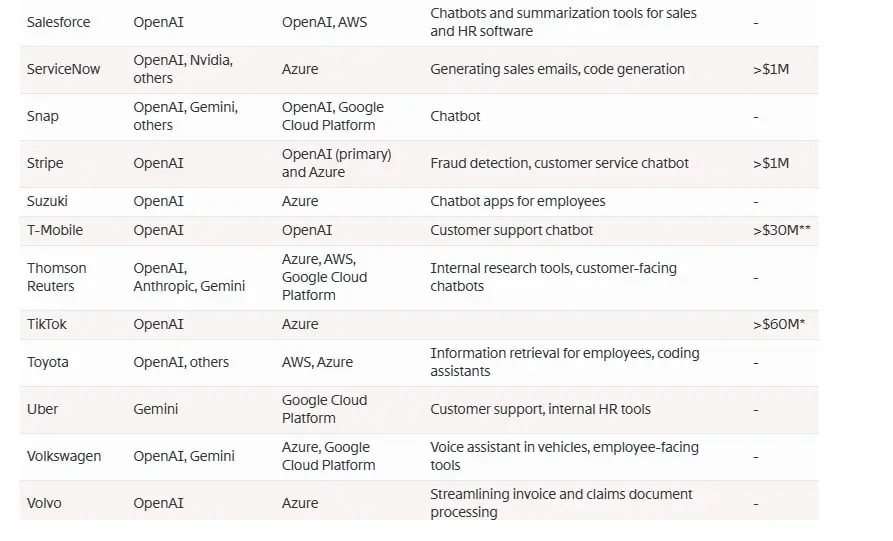
The Information We have prepared a report on the spending of the largest companies on generative models. Mostly it is, of course, LM-ki, but some still generate pictures for creatives.
The table itself isn't very handy, so I ran it through the LLM to put it into groups for clarity:
1. Customer Support/Service
- AT&T: Customer service chatbot
- Doordash: Customer support/contact center chatbot, voice ordering, menu, and search optimization
- Duolingo: Generating lessons, audio, and chatbot for conversational practice
- Elastic: Sales, marketing, and information retrieval internal tools
- Expedia: Customer-facing chatbot, internal tools
- Fidelity: Generating emails to customers and other materials
- Freshworks: Customer service chatbot, employee HR chatbot, document summaries
- G42: Customer-facing chatbots for healthcare, financial services, and energy sectors
- H&R Block: Customer-facing chatbot in tax software
- Ikea: Customer-facing chatbot on the website
- Klarna: Customer service chatbot and HR software
- Intuit: Chatbot and customer service features
- Mercedes Benz: Call center automation
- Oscar Insurance: Customer-facing chatbot in insurance claim software
- Radisson Hotels: Customer service assistant for managing bookings
- Snap: Chatbot
- Stripe: Customer service chatbot and fraud detection
- Suzuki: Employee chatbot apps
- T-Mobile: Customer support chatbot
- Uber: Customer support and internal HR tools
- Volkswagen: Voice assistant in vehicles, employee-facing tools
2. Marketing/Content Generation
- Coca-Cola: Generating marketing materials and AI assistants for employees
- Autodesk: Support, code generation, and sales
- IPG: Content generation and employee-facing chatbot
- Walmart: Curating personalized shopping lists, generative AI-powered search, assistant app
- Wayfair: Code generation
- Wendy’s: Generating suggested orders for customers
3. Document Processing & Information Retrieval
- Morgan Stanley: Information retrieval for wealth management
- Pfizer: Search documents by voice command and chatbot
- Toyota: Information retrieval and coding assistants for employees
- Volvo: Streamlining invoice and claims document processing
- Zoom: Meeting summarization
4. Development/Code Generation
- Goldman Sachs: Code generation, document search, summarization
- ServiceNow: Generating sales emails and code generation
- GitLab: Code generation
- Notion: Summarization and text generation
5. Employee & Internal Tools
- Fidelity: Emails to customers and other materials
- Salesforce: Chatbots and summarization for sales and HR The most interesting thing is probably the voice assistant in the car from Volkswagen and the funny comment about Pfizer. (Do you still remember the covids?). The latter use a voice assistant to search for documents (No one else works by voice.)Except for the Duolingo students. The green owl, by the way, is good at integrating LLM into its product.
Other use cases are quite banal: sammari, especially for HR; moronic costumer-support chatbots (By the way, does anyone even use them?)Enterprise subscriptions to ChatGPT, Claude or Gemini to optimize employee performance and generate emails. Nothing remarkable. However, it is interesting how each company uses LLM in its work.
And finally, the score among the top models is as follows:
OpenAI — 43
Gemini — 19
Anthropic — 12
I’m even a little surprised that Gemini has more customers than Antropics, probably because of the context of 2M tokens. By the way, companies usually use one or two bots, so the total amount is obviously higher than that. 50.
@ai_newz