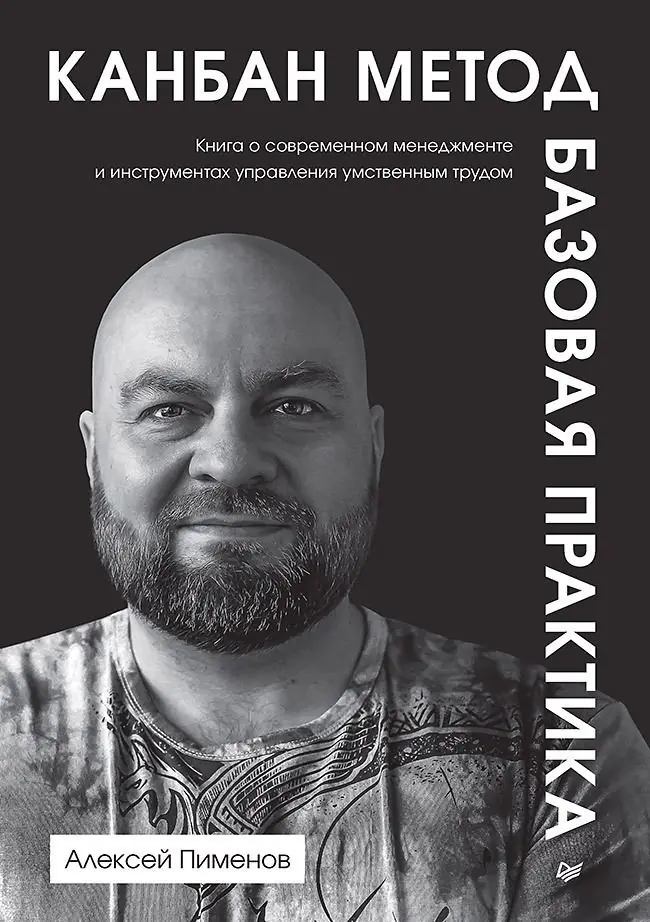
Kanban Method. Basic practice
I finished reading this book by Leshi Pimenov, which is devoted to the optimization of intangible production processes. Immediately, starting with the cover, Alexey overturns all the basic ideas about Kanban.
- It was invented at Toyota.
- It has boards and stickers. Limit the amount of unused work. And then there's the build-up from the old kanban to the new one that David J Anderson invented and turned it into Kanban Univerysity. (course-based). Let's leave aside the very approach to choosing a word already used, and then explain to everyone that this word now means something else on the conscience of David J. Anderson. Consider the book itself, which consists of four sections.
1. Intangible production This section gives a brief reference to the history when production was material and one could see how materials and unfinished production moved through the stages of the process. (Like Toyota.). But in conditional development, we don't see this movement anymore, and we need to do squats for visualization. (Where does the leg grow from the famous boards with tickets)
2. Introduction to the Kanban Method It all starts with the principles of change management.
- Start with what you have now. (If you think about a phrase, it’s hard to start with something else.) Arrange for evolutionary development (There are no revolutions and gradual improvements. n) Encourage leadership at all levels Next, the author proceeds to consider the principles of value delivery
- Starting with the definition of what value-service
- Continue. development improve Noting the importance of understanding and focus on customer expectations
- Speaking of importance. management of work, not people The author concludes with an analysis of basic practices.
- Visualization.
- WIP limits.
- Flow control
- Clear rules.
- Use of feedback loops Cooperative development based on models and scientific approach
3. Let's start using kanban. Here the author talks about how to study and improve the processes in practice, or rather about the
- Process metrics
- Life cycles.
- Service classes How to build a kanban system: about the obligations in such a system, its components, how to design tickets and the board itself. Separately handled by STATIK (System Thinking Approach To Introducing Kanban)
4. Improving the Kanban system In this section, it is assumed that we already have a kanban system and we continue to use it as a fine tune.
- Cumulative flow diagram (cumulative flow diagram)
- Work with narrow links (How to identify them and what to do with them) Working with non-permanent availability resources (What is it and how to be with them?) What to do with variability and how to use probability theory and mass service (Very interesting part about dealing with risks) Separately understand the types of meetings and their rhythm in the Kanban system
To summarize, here is my opinion on the book. The title of the book did not deceive – it really contains basic practices on process management. These practices are useful and it would be good for the manager to know about them and be able to apply them. The book itself is great for aspiring leaders, as it describes these practices and shows literally on your fingers how they should be used for your own benefit. For experienced managers, the book may seem boring - it discusses very basic things, and a large number of diagrams in some parts, although useful to beginners, but experienced people think "yes, everything is already clear, and then something else."
I highly recommend this book to leaders and those who plan to become leaders. If you understand everything and it seems obvious to you, then this is very good and you can dig deeper. If you do not understand everything, the book will help you to raise your level. In general, this book roughly pulls to the level of the development teamlid.
About improving the development of software, I also somehow told And I was talking about kanban from the book "Making Work Visible," which I once wrote. sammari.
#Processes #Management #Leadership #Software #Kanban