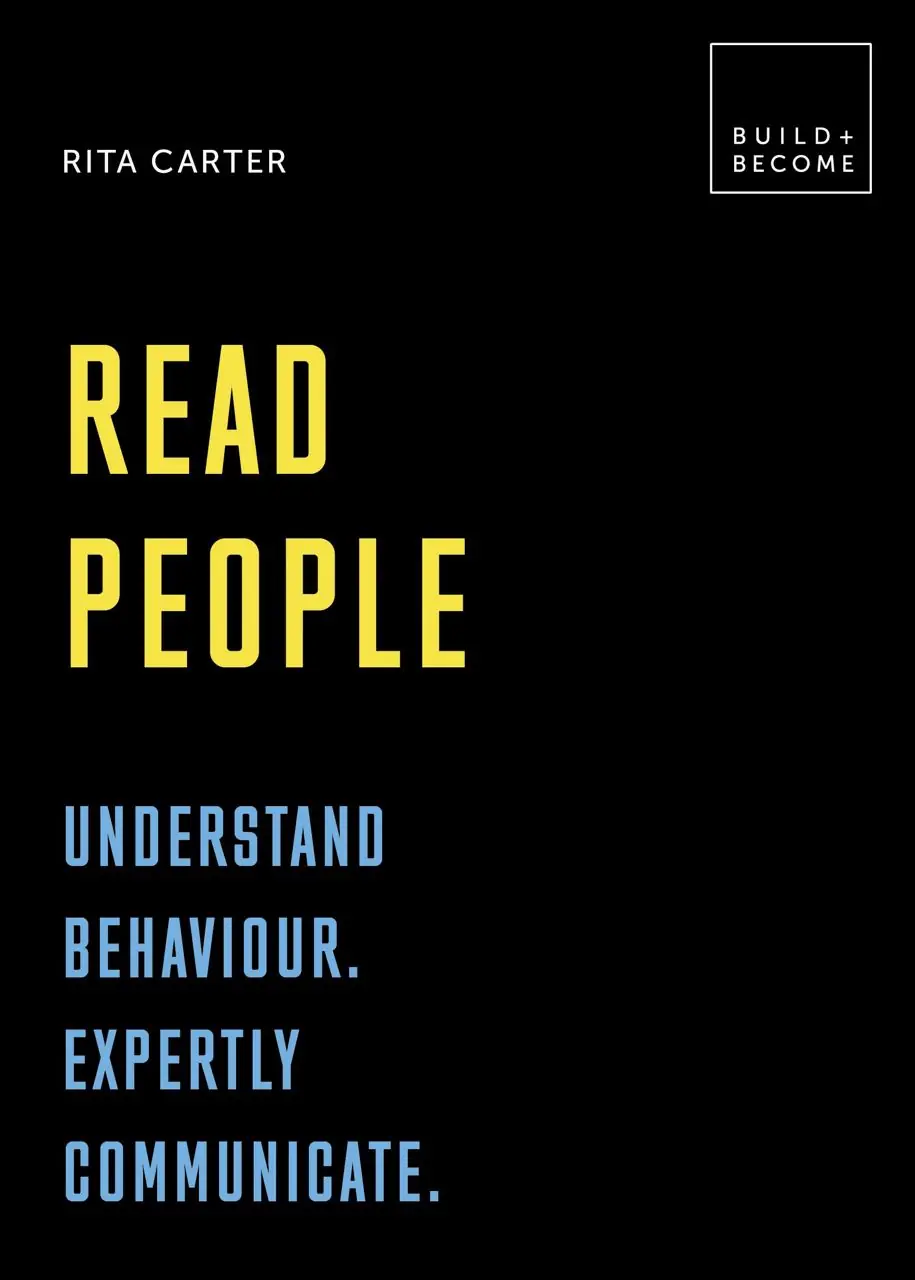
Today I finished reading Rita Carter’s book Communications. Learn to understand others and communicate productively, in which the author addresses the issues of human interaction in general.
I finished reading Rita Carter's book today.Communications. Learn to understand others and communicate productively", in which the author considers the issues of interaction of people in general. This book is part of the Think Different series and is titled Read People: Understand Behavior. Expertly communicate”. Adam Ferner's book "Decision Making" from the same series I wrote a little earlier.. In the book of everything 5 parts, in each of which the 4 The lessons and the tools and recommendations at the end of each section. Here are the topics the author discusses. (See more in the attached picture with the content of the book)
- Face to face. The whole chapter is devoted to physiognomy and rather dubious examples of what can be known by the size and color of the eyes or facial symmetry. For me, the material in this chapter is more of a cliche than useful information.
- Emotions and their expressions - a story about the main emotions of a person: disgust, fear, sadness, joy, anger, surprise. The author also talks about how they are expressed on the face and through body language, as well as about the dress code and how people change depending on the clothes. Here the author remembers Paul Ekman and the series “Lie to me”, which was filmed based on the work of this scientist.
- Personality and human nature Here the author talks about the options for classifying people, for example, about the OCEAN test. (openness to experience, conscientiousness, extraversion, benevolence and neuroitism) MBTI test for Myers-Briggs personality type (introversion-extroversion, sensation - intuition, thinking - feelings, judgment - perception). And then from such classifications, parallels are drawn to the behavior of people. There are different views on how these classifications work.
- Communication and influence In this chapter, the story begins with how conversations between people usually work and the author immediately recalls Eric Berne’s theory of transactional analysis and his classic books “Games People Play.” (I told her. earlier) and "People Who Play Games." (About her, too. told). Then comes the story of instincts and influence and recalls the classic book by Dale Carnegie "How to win friends and influence people." And in the part about persuasion, Cialdini’s works are recalled, or rather, “The Psychology of Influence.” Well, the chapter ends with the consideration of questions of confidence and self-confidence, and then the mechanics of the crowd. I liked this chapter the most in this book:)
- How to Read Society – This chapter explores how groups, families, group thinking, and crowds work. In the part about the group, the Maslow pyramid and the Dunbar number are considered. The family part examines how oxytocin works and how it acts as a “glue” for family members. In the part about group thinking, questions of extreme conformity and its dependence on culture are considered. In the end, the classification of crowds is given.
In the epilogue, the author sums up what is put in the English title of the book, namely “Read people”, that is, how to read people. Funny that one of the final tips is a reminder to just ask. And the final paragraph is devoted to the fact that if the reader wants to learn to read people, then people around him often want to understand him, so it is important to make sure that you "write" yourself clearly enough to read:)
#Communiction #PopularScience #Psychology