T-Meetup: R&D in Vladivostok (Category RnD)
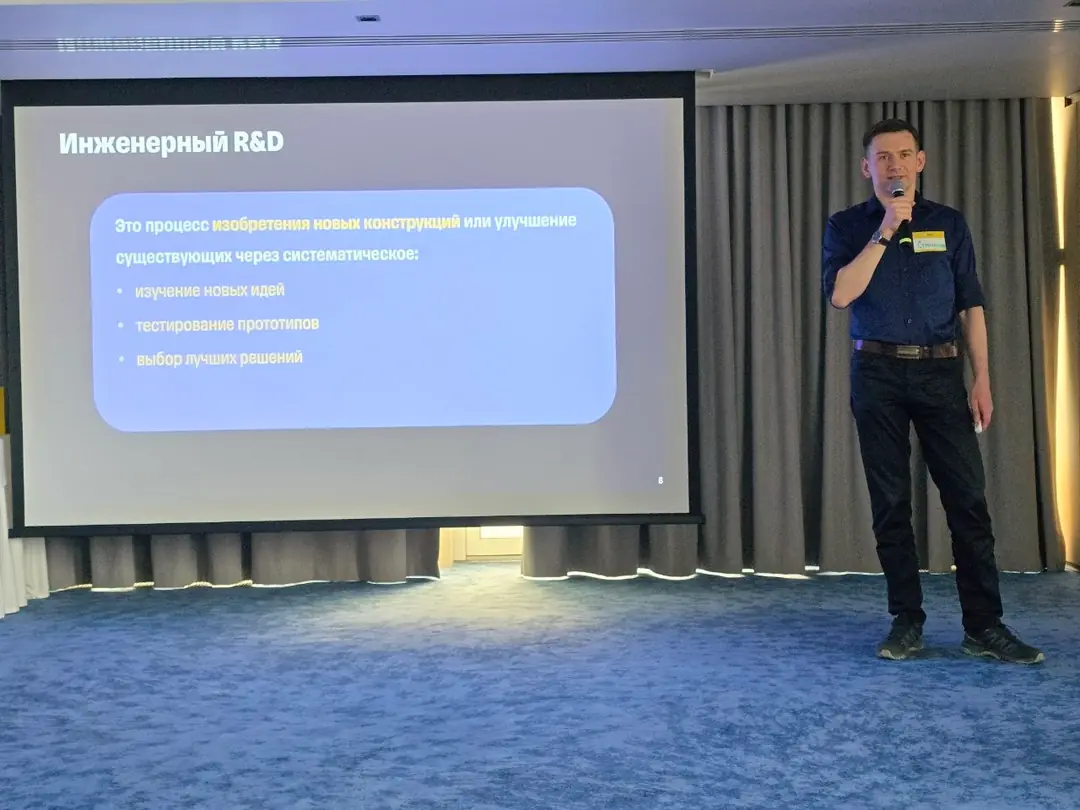




I spent most of this week with colleagues from the R&D centre at our development centre in Vladivostok. It is beautiful here, and the food is delicious :). This evening we had an R&D meetup, with three talks on how R&D differs from ordinary development and a couple of concrete research cases:
- “Why Are There Problems That Ordinary Development Cannot Solve?” by Stanislav Moiseev, Director of Engineering Research at T-Bank. We flew in together from Moscow.
- “Code Knowledge Graphs as Memory for LLMs” by Mikhail Baderik, an R&D engineer at our Vladivostok centre.
- “Evolutionary Agents in Practice: Open Source and Real Problems” by Danial Matienko, another R&D engineer at our Vladivostok centre.
I wanted to discuss Stas’s talk separately: it explained research and development in large IT companies, particularly T-Bank.
He began by distinguishing R&D from product development:
- Product development asks “What should we build, and how?”, using existing “instructions.”
- R&D asks “Can this be done at all?” It addresses technological risks by testing hypotheses and developing new methods and technologies.
Countries approach R&D differently:
- United States: a capital-intensive model with startups, corporate research centres — Apple’s closed model, Microsoft Research’s fundamental research and Google’s hybrid approach — and strong university labs. Incidentally, we discussed Google’s approach on the podcast in late 2023, with Stas as a guest. The hybrid element is the deep integration of research teams into product processes. A key principle is that the research team writes production code from day one, keeping research connected to practice and accelerating adoption.
- China: a model based on cooperation and state influence, with close company–university collaboration, central planning and substantial public investment. Huawei, for example, spends more than 20% of revenue on R&D.
- Russia: historically a strong system of sector-specific research institutes. Research is now increasingly moving inside large IT companies. Import substitution and rapid AI development are driving greater R&D investment.
Stas then described T-Bank’s engineering R&D areas: 1. Engineering productivity: AI tools to improve engineers’ effectiveness, including a code review service, a unit test generator and Data Scout for automatically assembling datasets. 2. Large graph analysis: building a platform to process graphs that do not fit in RAM, for recommendations, fraud prevention and infrastructure analysis. 3. Data platform optimisation: speeding up SQL queries through approximate computation on sampled data. He described 10-fold acceleration while retaining 99% accuracy. 4. Logistics optimisation: hierarchical clustering algorithms for courier routes. Rollout across 16 regions had already reduced distance travelled by 9%. 5. Blockchain: transaction analysis, fraud detection and investment tools built on distributed ledgers.
Stas concluded that successful R&D teams need more than a budget and difficult problems: they also need realistic timelines, talented people and a culture that gives researchers enough freedom.
The useful ideas I would take away are: 1. Assess technological risks when launching products. 2. Integrate research and development, avoiding isolated research teams. 3. Read openly published research. 4. Look for optimisation opportunities. 5. Build the right culture.
#RnD #Engineering #Software #Management #Leadership