Noise: A Flaw in Human Judgment (Noise. Imperfection of human judgment) (Books column)
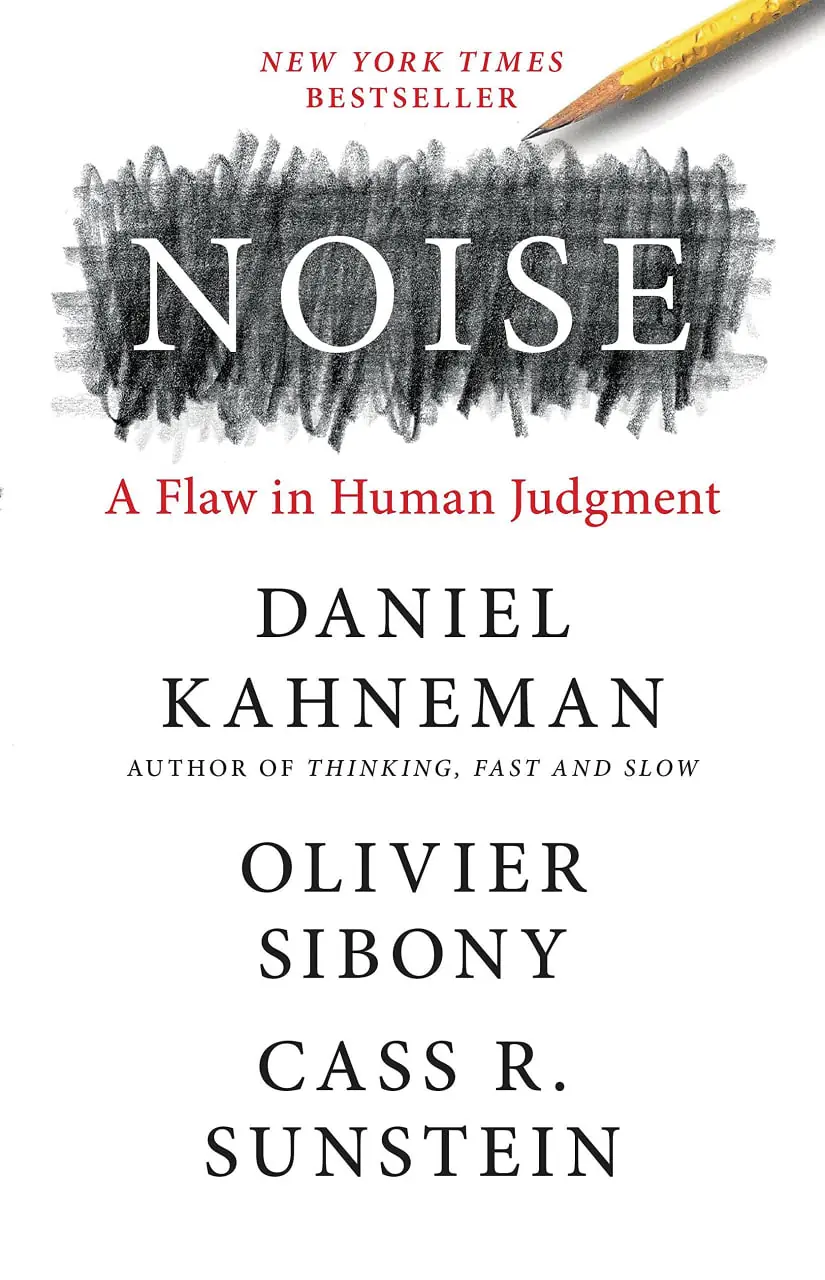
I recently finished reading the book Noise by three authors Kahneman, Siboni and Sunstein, in which respected scientists said that bad decisions arise not only because of bias, that is, systematic bias, but also because of variability: different people or the same person at different times make different decisions where the solutions should be the same.
This book has been hard for me – I’ve been reading it for over a year and it has a couple of things to do with it.
1The authors have delayed the book to 500+ pages, although the main content was easy to fit in 250 The pages were about the error.
E[(y'−y)*(y'−y)] = (E[y']−y)*(E[y']−y) + V[y'] Average error: average error or bias variability of error or just the noise that the authors propose to deal with
2The book is a joint work of three authors and there is no consistent and single author's voice. Daniel Kahneman, a Nobel laureate, set the frame for the book and gave large letters for the cover - after all, he is the author of the book "Thniking, Fast and Slow". ( I already am. handler earlier). The second author, Olivier Siboni, was an employee of McKinsey for more than a quarter of a century and brought consulting and organizational expertise and the theme of strategic decision quality to the book. And Cass Sunstein added editorial support.
As for the main sections of the book, there are two.
1Statistical If all the judges, interviewers or architectural reviewers are on average right, but each time they give very different answers, the system is still not very good. 2и Organizational Most companies do not measure scatter. They believe that their leading experts reason in roughly the same way, but this is often an illusion.
The authors propose to look at the decision-making system as a measurement process. If you have ten thermometers on one table showing different temperatures, you don't say "what an interesting pluralism of opinions"; you calibrate the instruments. The authors suggest the same look at people in professional decision-making systems: recruitment, performance review, diagnosis, forecasting, risk assessment, strategy.
The authors give the following typology of noise — Level noise One person/judge/manager is systematically stricter or gentler than another — Pattern noise Different people react differently to different signs — Occasion noise The same person changes judgment because of context: fatigue, mood, time of day, heat, previous case, order of discussion (And there is both inter-expert noise and intra-expert noise.)
Interesting ideas that I found useful (Only a few of them were relatively new to me.) 1️⃣ Noise can be measured without knowing the correct answer. ground truth is needed to measure displacement, and noise can be estimated by the degree of variability 2️⃣ Meetings often reduce information levels The loud/important person who speaks first can win the opinion to his side and we will never know about the real opinions of other people. 3️⃣ Performance review is a very noisy process. (According to the authors' statistics, about a quarter of the score is related to the actual level of performance, and the rest is noise.) 4️⃣ There. noise auditing The basic approach is to give the same cases to several independent experts, collect answers, calculate the spread and further evaluate the effects. 5️⃣ There are hygiene measures for decision-makingIndependent evaluations before discussion, aggregation, structured rubrics, comparative scales instead of absolute, division of the solution into sub-problems, delayed appeal to intuition after previous rational steps. 6️⃣ Algorithms remove noise but do not guarantee fairnessThe algorithm can be stable – the same inputs give the same result, but it can enhance systematic bias if the data or optimization function is poor.
P.S. The authors’ approach fits perfectly into the agency of all processes – in doing this, we are struggling with systemic bias and variability.
#Thinking #SelfDevelopment #Brain #Economis #Leadership