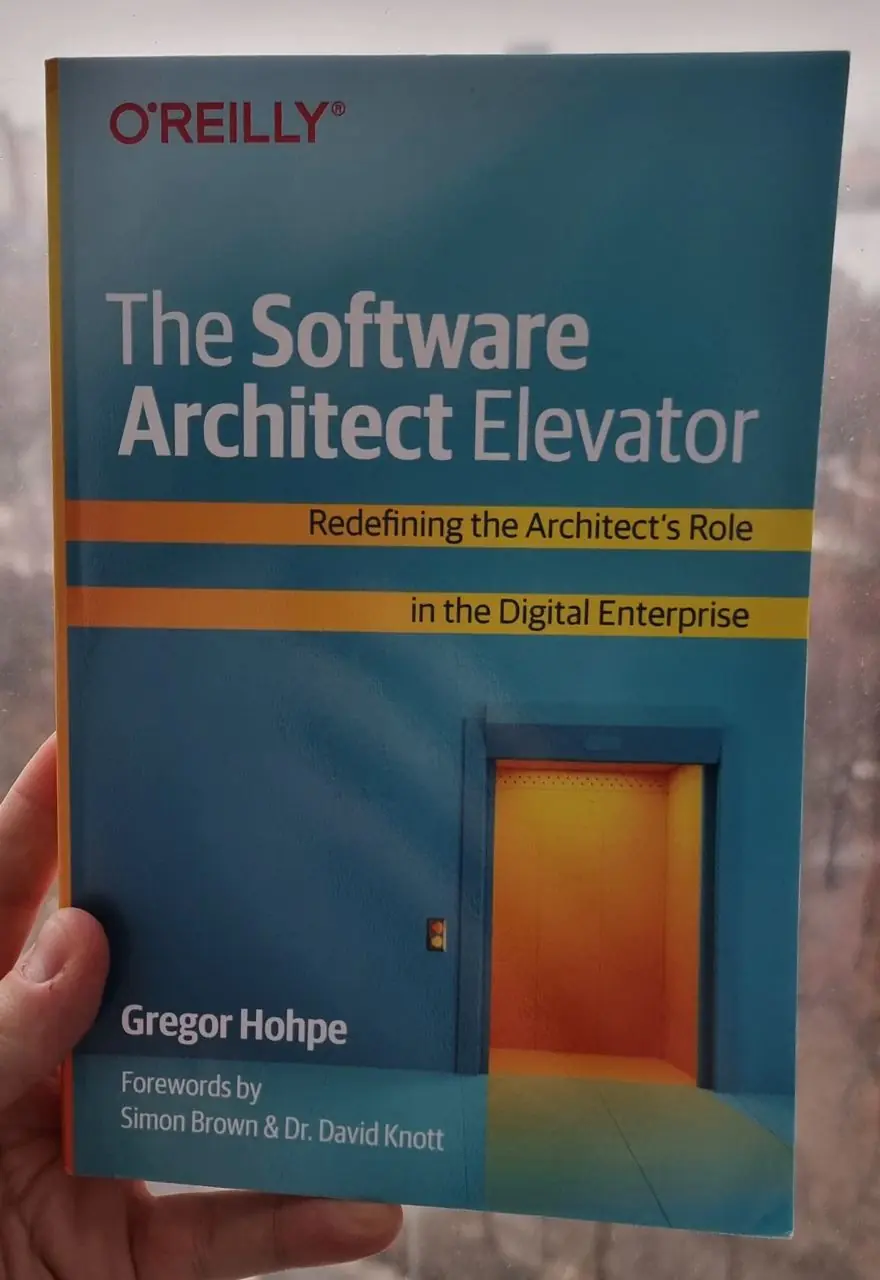
The Software Architect Elevator (Redfining the Architect's Role in the Digital Enterprise)
I read a great book by Gregor Hohpe. 20 He wrote a book called Enterprise Integration Patterns. Gregor has worked at Google for years. 7He is also the chief architect of large corporations, which he helped move into the digital world. The result is a book about the elevator for the architect, in which he shares his views on the role. The book itself consists of 340 pages broken down 41 chapters that are combined into 6 parts
- Architects Here the author talks about different types of architects and shares a metaphor about the elevator, talks about the speed of development and its acceleration. (as the first and second derivative of the current coordinate), reflects on enterprise architecture as a link between business and IT, leads 3 Architect base: skill, impact, leadership, talks about decision-making and the ability to ask complex questions
- Architecture Here the author discusses what architecture is, what it is, and also shares a set of cool principles that help in the work, for example, "never send a human to do a machine's job" and such principles are many and they are discussed in detail in individual chapters.
- Communication Here the author begins with the thesis "you can't manage what you can't understand" and then moves on to how to embrace concepts, how to engage the audience, how to write for busy people, how to highlight the important, not try to describe everything, how to use diagrams for design and connect different meanings, and this part ends with the statement that "software is collaboration".
- Organizations Here the author immerses himself in the theory of organization, but from the practical side. He talks about how to reverse engineer an organization, how control is an illusion, shares his thoughts on why architects love pyramids, and corporations often have a black market, how to scale an organization, and why slow chaos is not order, and ends with a discussion of what governance is.
- Transformation The author says that without pain there is no change, how to lead these changes, discusses the economy of scale and the economics of speed, talks about the endless cycle of learning and feedback, why it is difficult for corporations to attract talent, about the theory of queues and how to build thinking in a multidimensional world.
- Epilogue: Architecting IT Transformation In the end, the author invites architects like Neo to take the red pill and, with newfound knowledge, wake up in their corporation and start changing it towards a digital enterprise.
#Management #Leadership #SoftwareDevelopment #Software #Architecture #Architect