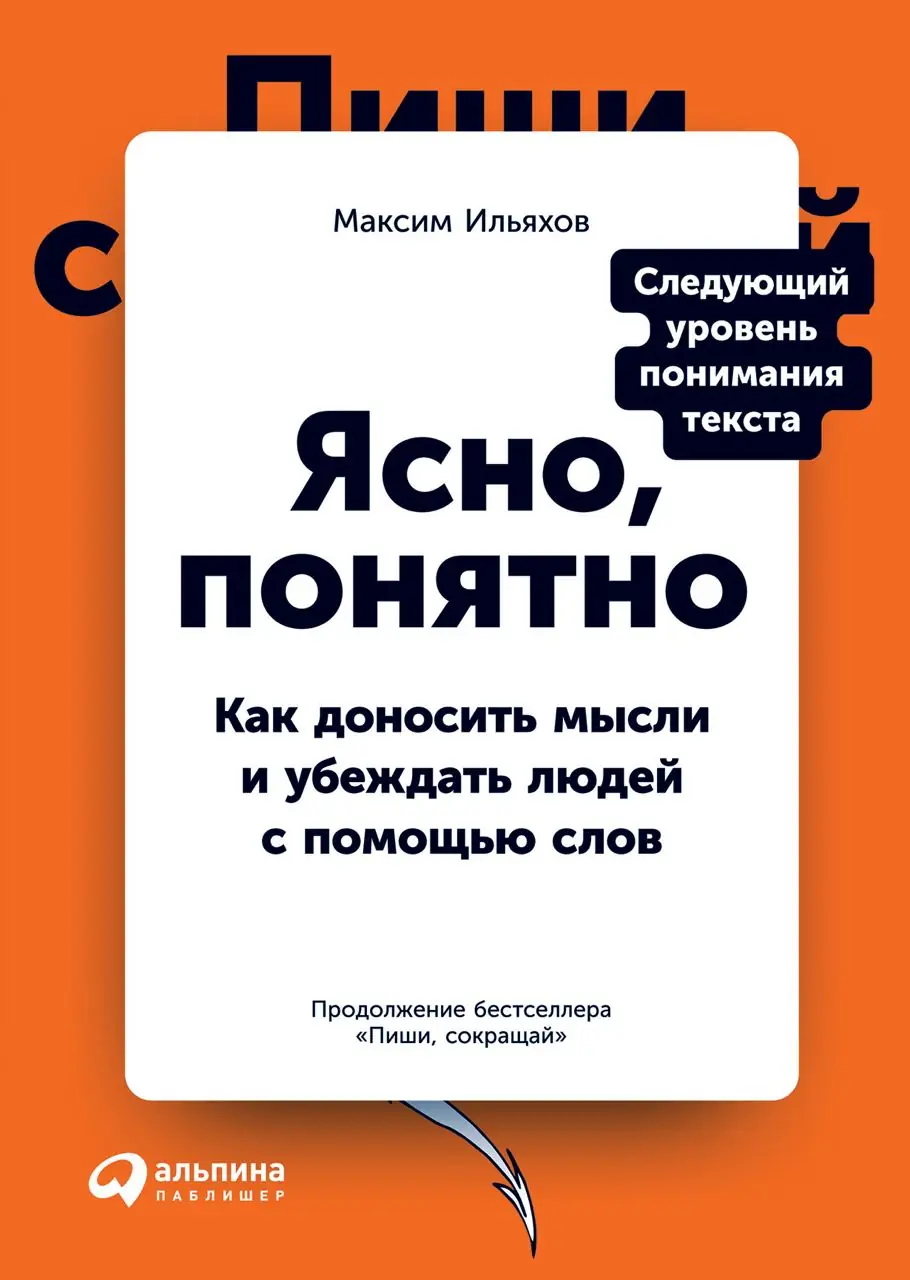
Okay, okay. How to communicate thoughts and convince people with words
This book by Maxim Ilyakhov continues the book "Write, shorten", which is devoted to the so-called infostyle. This is an approach to editing text to simplify it, which is actively used by copywriters. About my perception of the first book I wrote I'm going to talk about the sequel in the form of the book "Clear, clear."
This book is far less ultimatum than Write, Cut. Perhaps this is because the book deals with higher matters: context and tone, the interests of readers, the clarity of the message, the importance of presentation. In fact, these four basics become the four parts of the book, which has as many examples and anti-examples as the first book. At the very beginning, Maxim follows his own advice from the depths of the book and gives a list of the main ideas that will be considered in the text. In the end, you get a list with the main thoughts in five minutes. - Right means nothing.. If you were right, but you were not understood, that is your problem. - Just writing is not enough.. It is necessary to make in the head of the reader formed a clear picture of what you convey to him. You can't ignore the context.. It affects the perception of your text. (where it is published when, what is happening in the world, etc.) Write about the reader, not yourself.. It is important to convey to the reader what he thinks is important, not us. - Promise me a favor.. Work well texts that are devoted to the urgent problems of readers - Promise simplicity.. This also increases the conversion rate to reading the text. - Promise me fun.. People like to feel emotions and can play it. - The reader thinks in images.. It is necessary to form pictures in the minds of readers. - Give examples.. This allows you to land abstract theses on the ground. Give an example - give an anti-example.. Show the reader how to make a mistake in interpreting the thesis, especially if he himself could make such a mistake. - Take the reader's side.. The reader feels the mood of the author, so it is useful to proceed from the fact that the reader is a good person. The main thing is close, the details are separate.. It is easier to read the author’s thoughts. It’s like being able to read the signature of an interface and then, if you want, fail to implement it in a particular class. (Here's an example.) - Don't hesitate to repeat.. At each step of working with information, losses occur, as a result, some mere percentages are remembered. To combat this thought is not a sin to repeat, in different versions and from different points of view. So feel free to repeat. - Spread them out. Here the author proposes to divide the text into parts: use paragraphs, subheadings, lists - Illustrate.. The author suggests illustrating his thoughts, but not just with a stub generated by DALL·E, but with something that carries semantics and adds meaning to the text.
In general, this book was definitely more interesting than the first. And I was able to read it not in a year, but in a couple of weeks:) I found it useful not only for those who are planning to write a book, but also for those who simply need to effectively communicate their thoughts to others:)
#Writing #Storytelling #SelfDevelopment #Leadership