Research Insights Made Simple
A podcast about whitepapers, research and engineering methodology in plain language
Each episode reviews one study or important engineering topic: what is actually useful, where the methodology has limits, and how to apply the findings in real software development.
Episodes by topic

Developer productivity: how DX measures it
DX history, DX Core 4, AI Measurement and CAFE(S), with 2024–2026 PR throughput data and guidance on comparing the reports.
Agents over Data: Why SQL Is Not Enough
Агент над данными: почему одного SQL недостаточно
What a data agent needs beyond SQL: metric definitions, data lineage and access rights. The Snowflake and Databricks comparisons and a protocol for comparing harnesses on one model.
AGENTS.md: Does a Context File Help the Agent?
Evaluating AGENTS.md: Are Repository-Level Context Files Helpful for Coding Agents?
How AGENTS.md affects coding agent behaviour, task success, and run costs on SWE-bench Lite and CTXbench.

How Much Harness Does a Strong Model Need?
Beyond the Model: Demystifying Harness Effects in Software Engineering Agents
When a strong model can use a simple harness and what changes on open-ended tasks, with evidence from NanoHarness and ML engineering agents.
Model or Harness: What Moves the Score?
Harbor Adapters and Harbor-Index
What changes when you swap an agent’s model or harness: evidence from 54 benchmarks, costs, timeouts, and the 82 Harbor-Index tasks.
Randomness in Agent Evals: Improvement or Noise?
On Randomness in Agentic Evals
Separating agent improvements from noise: repeated runs, zero temperature, pass@k and pass^k, trajectories, and evaluation budgets.

Agent Skills and Open Knowledge Format (OKF): Skills, Knowledge and Trust
Agent Skills and OKF with Maxim Smirnov: skill usefulness, evaluation, shared knowledge, RAG tradeoffs, and trust in agent outcomes. Guest: Maxim Smirnov.

Agent evals: telling whether an agent succeeded
Demystifying evals for AI agents
How to evaluate AI agents: outcomes and trajectories, graders, pass@k and pass^k, isolated trials, and checking success criteria themselves.
Agent Anatomy: Seven Harness Responsibilities
Harness Engineering: Anatomy, Architecture, and Evolution of Coding Agents. A Source-Code Study of Eleven Systems
Seven agent harness responsibilities: tools, context, permissions, isolation, and extensions. A review of eleven systems’ source code and the limits of its findings.
Anthropic: What Remains for People in a Company of Agents
How employment is changing at Anthropic
Anthropic's study of work with agents: hiring, productivity, human attention, engineering skills, and sharing the gains from automation.
Scion: Anthropic’s Git Replacement for Agentic Development
Redesigning source control at Anthropic
Anthropic's Scion: server-side version control, caches, speedup limits, and questions about post-merge checks.

Harness Design for Coding Agents: What the Harness Contributes
An Empirical Study of Harness Design for Coding Agents
What planning, tools, and context management contribute to coding agents: 176 settings, cost, failure causes, and testing on your own tasks.
AI and the Data Platform: Connecting AI to All Organizational Data
Four approaches to data for AI agents: warehouses, federated queries, universal databases, and shared storage. Copies, lag, cost, and open formats. Guest: Nikolay Golov.
Harness Design for Long-running Application Development
Harness design for long-running application development
A planner, generator, and evaluator for long-running application development: acceptance criteria, browser checks, run costs, and simplifying the harness when models change.
Harness engineering: agent environments
Harness engineering: leveraging Codex in an agent-first world
How an OpenAI team built an environment for Codex: repository knowledge, observability, architecture checks, background cleanup, and the move to Symphony.

Long-running Agents: Work Handoffs
Effective harnesses for long-running agents
How an agent resumes work after a context reset: environment setup, a feature list, progress notes, Git, and browser verification.
SWE-agent: Interfaces Change Outcomes
SWE-agent: Agent-Computer Interfaces Enable Automated Software Engineering
A solo SWE-agent review: search, editing, validation and context, SWE-bench ablations, and the shift from a specialized interface to mini-SWE-agent.
vLLM and PagedAttention: Virtual Memory for LLM Serving
Efficient Memory Management for Large Language Model Serving with PagedAttention
A review of the vLLM and PagedAttention paper: why LLM serving is bound by KV cache memory, how paged virtual memory from operating systems removed reservation and fragmentation, and how that bought 2–4× throughput without changing the model.
AI4SDLC: What I Would Do Differently
What to rent and what to own in an AI stack: agent loops, context, permissions, tools, and verifiable engineering tasks. The extended Deep Tech Night talk.

Developer Productivity: Google’s Human-Centered View
Developer Productivity for Humans
Developer Productivity for Humans: goals, measurement, builds, onboarding, quality, teamwork, and AI tensions through Google research and Alexander Polomodov’s reviews.
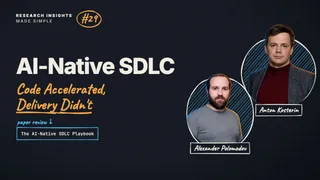
AI-Native SDLC: Code Accelerated, Delivery Didn't
The AI-Native SDLC Playbook
A review of the AI-Native SDLC Playbook: redesigning planning, design, build, test, deployment, and maintenance around AI agents, versioned artifacts, and human control points. Guest: Anton Kosterin.
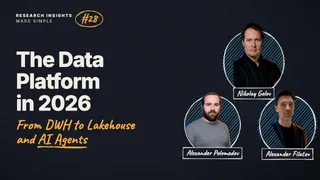
The Data Platform in 2026: From DWH to Lakehouse and AI Agents
How to separate OLTP from OLAP, where MPP warehouses reach their limits, what makes a lakehouse, why legacy migration takes years, and how AI agents change data-platform requirements. Guests: Nikolay Golov, Alexander Filatov.
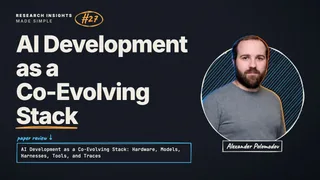
AI Development as a Co-Evolving Stack
AI Development as a Co-Evolving Stack: Hardware, Models, Harnesses, Tools, and Traces
How hardware, models, harnesses, tools, traces, and evals form a co-evolving AI-development stack, and where enterprises should draw the rent, adapt, and own boundary.
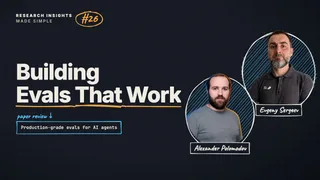
Building Evals That Work
Production-grade evals for AI agents
How to turn AI-agent evals from one-off answer grading into a reproducible engineering system with replayable episodes, hidden judges, traces, scorecards, and release gates. Guest: Evgeny Sergeev.
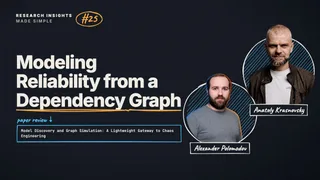
Modeling Reliability from a Dependency Graph
Model Discovery and Graph Simulation: A Lightweight Gateway to Chaos Engineering
How to derive a dependency graph from traces, estimate availability with Monte Carlo, and prioritize chaos experiments. Guest: Anatoly Krasnovsky.
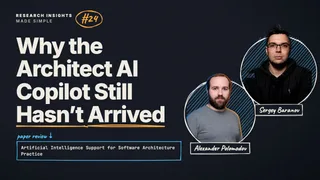
Why the Architect AI Copilot Still Hasn’t Arrived
Artificial Intelligence Support for Software Architecture Practice
What AI can do in software architecture, where context breaks, and why humans remain accountable for architectural trade-offs. Guest: Sergey Baranov.
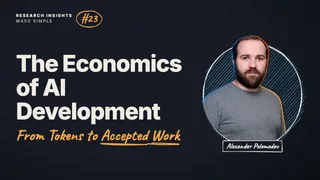
The Economics of AI Development: From Tokens to Accepted Work
Why cheaper tokens do not guarantee a smaller AI budget, and how to manage cost per accepted task, trace budgets, routing, and local-model TCO.
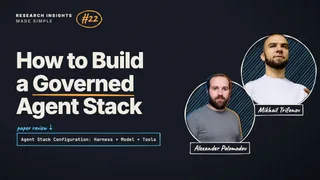
How to Build a Governed Agent Stack
Конфигурации агентного стека: обвязка × модель × инструменты
How to choose a harness, model, and tools, define data and authority boundaries, and turn an agent stack into a governed enterprise system. Guest: Mikhail Trifonov.
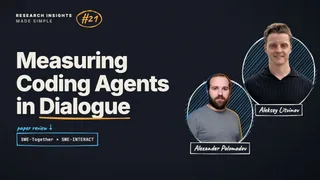
Measuring Coding Agents in Dialogue
SWE-Together × SWE-INTERACT
A review of SWE-Together and SWE-INTERACT with Aleksey Litvinov: measuring coding agents when requirements emerge during the work. Guest: Aleksey Litvinov.
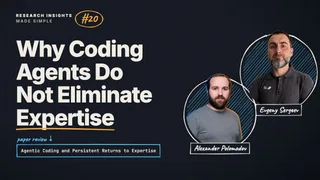
Why Coding Agents Do Not Eliminate Expertise
Agentic Coding and Persistent Returns to Expertise
A review of Anthropic's research with Evgeny Sergeev: why coding agents amplify domain expertise rather than eliminate it. Guest: Evgeny Sergeev.
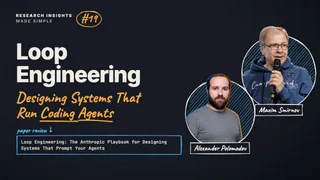
Loop Engineering: Designing Systems That Run Coding Agents
Loop Engineering: The Anthropic Playbook for Designing Systems That Prompt Your Agents
A review of Loop Engineering with Maxim Smirnov: agent loops, generator/evaluator, hidden debts, and safe autonomous-system design. Guest: Maxim Smirnov.
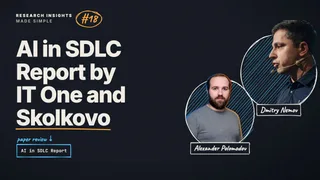
AI in SDLC Report by IT One and Skolkovo
AI in SDLC Report
A review of the AI in SDLC report by IT One and Skolkovo: AI adoption maturity, effect metrics and practical AI4SDLC questions. Guest: Dmitry Nemov.
Early-2025 AI and Experienced Developer Productivity
Measuring the Impact of Early-2025 AI on Experienced Open-Source Developer Productivity
A review of research on early-2025 AI and experienced open-source developer productivity: methodology, results and limitations. Guest: Artem Aryutkin.
Impact of Generative AI in Software Development
Impact of Generative AI in Software Development
A review of Impact of Generative AI in Software Development: speed, review, quality, context and organizational conditions for AI adoption. Guest: Igor Kurochkin.
What Goes Around Comes Around... and Around, Part II
What Goes Around Comes Around... and Around
Part two of What Goes Around Comes Around... and Around: recurring trade-offs in data systems and modern databases. Guest: Alexey Svetlichny.
What Goes Around Comes Around... and Around, Part I
What Goes Around Comes Around... and Around
Part one of the review of What Goes Around Comes Around... and Around: historical cycles in databases and recurring architectural ideas. Guest: Alexey Svetlichny.
DORA Methodology
DORA Methodology
A review of DORA Methodology: the origin of DORA metrics, research limitations and careful organizational use. Guest: Igor Kurochkin.
Measuring Developer Productivity With DX Core 4
Measuring Developer Productivity With the DX Core 4
A review of DX Core 4: delivery, feedback, cognitive load and flow as a compact developer productivity measurement model. Guest: Evgeny Sergeev.
Measuring AI Code Assistants and Agents
Measuring AI Code Assistants and Agents
A review of Measuring AI Code Assistants and Agents: evals, change quality, review load and AI's impact on the whole SDLC. Guest: Evgeny Sergeev.
Measuring Developer Experience With a Longitudinal Survey
Measuring Developer Experience With a Longitudinal Survey
A review of Measuring Developer Experience With a Longitudinal Survey: measuring DevEx over time and linking surveys to process improvements. Guest: Artem Aryutkin.
What Do Developers Want From AI?
What Do Developers Want From AI?
A review of What Do Developers Want From AI?: real developer expectations for AI tools, trust, context and everyday work. Guest: Nikolay Bushkov.
Measuring Developer Goals
Measuring Developer Goals
A review of Measuring Developer Goals: developer goals, work context, interruptions and the link between DevEx and real effectiveness. Guest: Alexander Kusurgashev.
Architecture Governance
Architecture Governance
An interview on architecture governance: principles, ADRs, standards, exceptions and architectural coherence. Guest: Pavel Lakosnikov.
Data Platforms
Data Platforms
An interview about data platforms: self-service, ownership, data quality and platform thinking for data. Guest: Nikolay Golov.
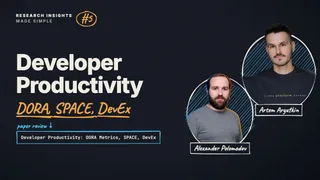
Developer Productivity: DORA Metrics, SPACE, DevEx
Developer Productivity: DORA Metrics, SPACE, DevEx
A developer productivity episode on DORA, SPACE and DevEx: how to measure engineering effectiveness without turning metrics into team rankings. Guest: Artem Aryutkin.
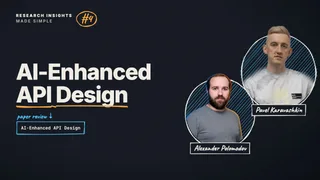
AI-Enhanced API Design
AI-Enhanced API Design
A review of AI-Enhanced API Design: where AI helps with API design, how to validate results and why responsibility stays with engineers. Guest: Pavel Karavashkin.

Secure by Design at Google
Secure by Design at Google
A review of Secure by Design at Google: secure defaults, platform constraints and engineering practices that make security part of design. Guest: Artem Merets.
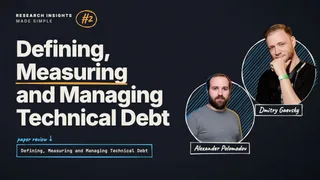
Defining, Measuring and Managing Technical Debt
Defining, Measuring and Managing Technical Debt
A paper review on technical debt: definitions, measurement, risk management and the connection between debt and delivery speed. Guest: Dmitry Gaevsky.
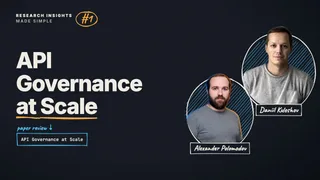
API Governance at Scale
API Governance at Scale
A review of API Governance at Scale: API catalogs, ownership, design reviews and rules that help large organizations evolve APIs without chaos. Guest: Daniil Kuleshov.
Why listen
- 01Understand whitepapers faster before deciding whether to read the full text
- 02Separate strong research findings from methodological constraints
- 03Connect research findings with engineering practice: AI in SDLC, DevEx, productivity and governance
- 04Build a map of ideas for architecture and organizational decisions in large-scale software development
Episode format
One episode, one paper
Each episode is anchored in a specific research paper, report or whitepaper.
Methodology matters
We look at study design, samples, limits, metrics and what should not be overgeneralized.
Practical translation
Academic and industry research gets translated into engineering decisions, process changes and management trade-offs.
Topics covered
The episodes follow several lines: productivity, AI4SDLC, governance and platform thinking.
Where to listen
The podcast is available in audio and video - pick the platform that fits.
YouTube - all 48 episodes
Playlist with video versions where slides, quotes and review structure are easy to follow.
VK Video - published episodes
Video versions on the shared Book cube channel in VK Video.
Podster - audio podcast
Audio version for commutes, walks or long-form research briefings.
Yandex Music - audio podcast
Audio archive on Yandex Music for listeners who keep podcasts in their everyday app.
Apple Podcasts - audio podcast
The podcast page on Apple Podcasts for listening and following in Apple apps.
Who it's for
- Engineers and architects who want research without academic noise
- Engineering managers and CTOs making decisions about productivity, DevEx and AI tooling
- Platform teams looking for arguments around governance and internal standards
- People who want to read papers more deliberately and find applicable ideas faster
Listen to the first episode
49 whitepaper and engineering research reviews. Start with API Governance at Scale or pick a topic in the episode catalog.
Open the YouTube playlist